

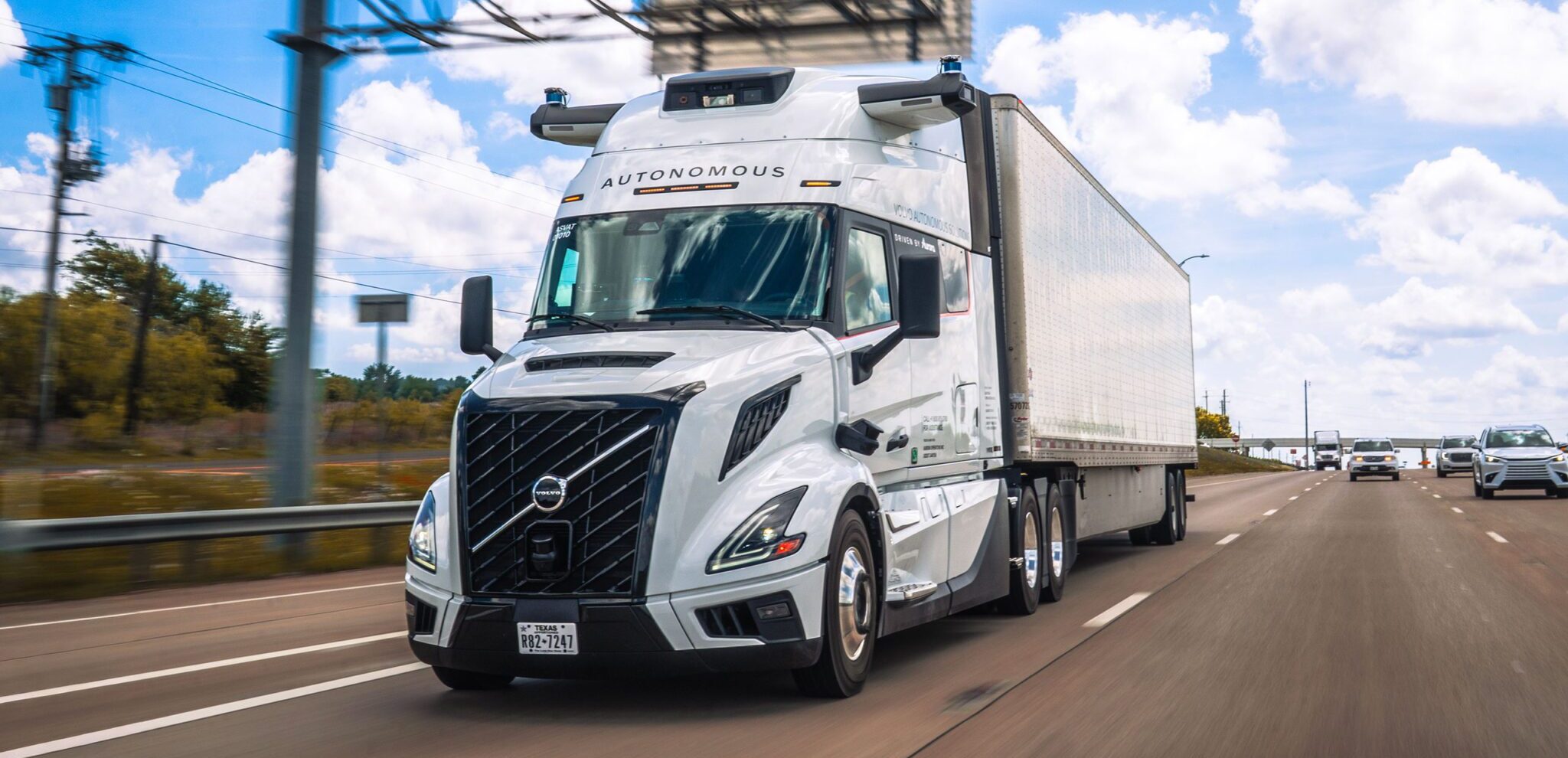
Volvo Group has been among the most forthright legacy truckmakers in embracing autonomous driving technology. By Stewart Burnett
Volvo Group has set out its most detailed and ambitious autonomous trucking timeline to date, targeting driverless on-highway operations in the US during Q1 2027 and projecting autonomous transportation revenue approaching US$3bn within five years. The goals were presented by Nils Jaeger, Head of Volvo Autonomous Solutions, at an investor meeting in Sweden, wherein he described the truckmaker as a first mover preparing to scale a business it expects to become a substantial contributor to group profitability by the early 2030s.
The commercial model is built around a hub-to-hub architecture, with humans remaining in control for the first- and last-mile segments of haulage. Volvo’s purpose-built autonomous VNL, developed in partnership with Aurora Innovation and manufactured at Volvo’s New River Valley plant, will handle the predictable long-haul highway segment between logistics hubs. Autonomous Volvo trucks are already operating on Texas highways and in Norwegian mining operations with safety drivers present; Q1 2027 will mark the transition to driverless commercial service on those routes.
The core productivity argument rests on utilisation: Jaeger said that autonomous trucks could double vehicle utilisation by operating beyond the legal driving limits of human drivers, addressing the chronic labour shortages that have weighed on the North American trucking market for years. At the target economics of roughly US$380,000-$420,000 in annual revenue per vehicle at scale—a figure consistent with Volvo Autonomous Solutions’ Freight-Capacity-as-a-Service model—300-plus vehicles on highway by end-2027 would represent a commercially significant initial base from which to compound.
Volvo Autonomous Solutions is not operating in isolation. Aurora Innovation, whose Aurora Driver software is integrated into the VNL Autonomous, listed on Nasdaq in 2021 and has been running commercial freight operations in Texas. Einride, which made its own Nasdaq debut on 10 June, operates electric and autonomous freight under a similar as-a-service model. The simultaneous emergence of multiple autonomous freight platforms seeking public capital on the same day strongly indicates that the sector has moved from development-stage into a phase where investors are being asked to price commercial execution rather than technology potential. Tesla’s valuation has long been tied to its autonomy and AI ambitions; unlike Tesla, other autonomy players will have to do something to meaningfully earn that valuation.
On the broader business, Chief Financial Officer Mats Backman described customer demand as solid in Europe through April and May, with North American demand characterised as strong and production capacity gradually increasing for the third and fourth quarters. Cost inflation is tracking upward, linked to rising freight and raw material costs tied to the US-Israeli invasion of Iran, and this will inevitably affect second-quarter results. Volvo’s truck and construction equipment units are both expected to outperform historical growth rates, although no specific timeframe was given.
The electrification picture remains infrastructure-constrained rather than technology-constrained. Volvo has sold more than 6,000 electric trucks across 50 countries since 2019, with the fleet logging more than 400 million kilometres in customer operations. Its latest FH Aero Electric reaches 680 km on a single charge at 48-tonne gross combination weight with 700kW charging capability. The company is pursuing a three-track strategy across battery-electric, hydrogen fuel cell and combustion engines running on renewable fuels.