

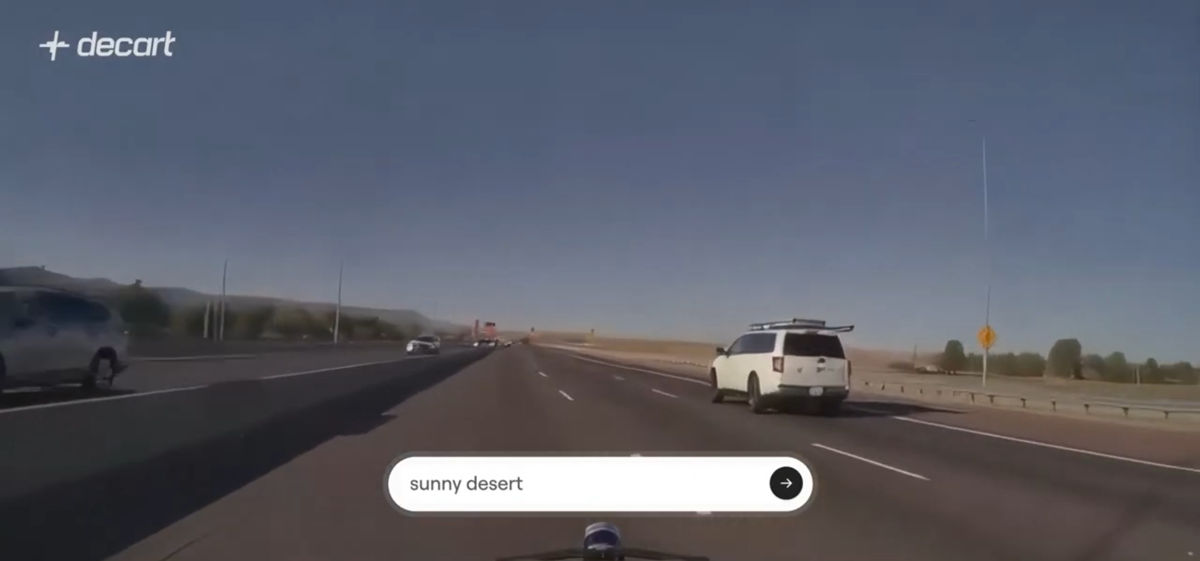
If you’ve ever wondered how companies like Waymo teach their cars to drive, a big part of the answer is real-world data. Waymo puts sensor-laden vehicles on actual roads and logs millions of miles so its system can learn how to handle what it encounters. That works well for common scenarios. But some situations are harder to manufacture. You can’t guarantee you’ll encounter black ice, or the specific chaotic intersection your system needs to learn from, just by putting cars on roads. Decart thinks it has an answer to that problem, and it’s called Oasis 3 autonomous driving simulation.
For those unfamiliar, a world model is essentially an AI that has learned enough about how the real world looks and behaves. From there, it can generate new versions of it from scratch. Google DeepMind has been building similar technology with its Genie series. However, Oasis 3 is purpose-built for driving rather than general world generation.
Oasis 3 is Decart’s world model built specifically for driving. Describe a rainy highway in Japan to it, or a chaotic intersection in a city your fleet has never visited. It generates a photorealistic, multi-camera environment your autonomous vehicle system can actually train and test against. Front-facing and side feeds included. And unlike a thirty-second demo, it runs indefinitely, which is the whole point. Edge cases aren’t useful if you can only run them once.

Oasis 3 Is Available Now via API
Decart launched Oasis 3 on Wednesday, and it’s available right now via API at $0.02 per second. Developers can plug straight into it without training their own models from scratch. The company is initially targeting autonomous vehicle companies. However, there are plans to expand into robotics and other physical AI applications down the road.
Decart co-founder and CEO Dean Leitersdorf told TechCrunch it’s designed to be “the first usable world model that people can actually program on top of.” That being said, Oasis 3 isn’t without its limitations. Testing found that environmental consistency degrades during extended use, and the model doesn’t yet simulate physics accurately enough to prevent cars from passing through objects in some scenarios.
Decart is aware of this and is actively working on it. For now, it’s a useful addition to the autonomous driving toolkit, but probably not something AV teams are running in isolation just yet.