

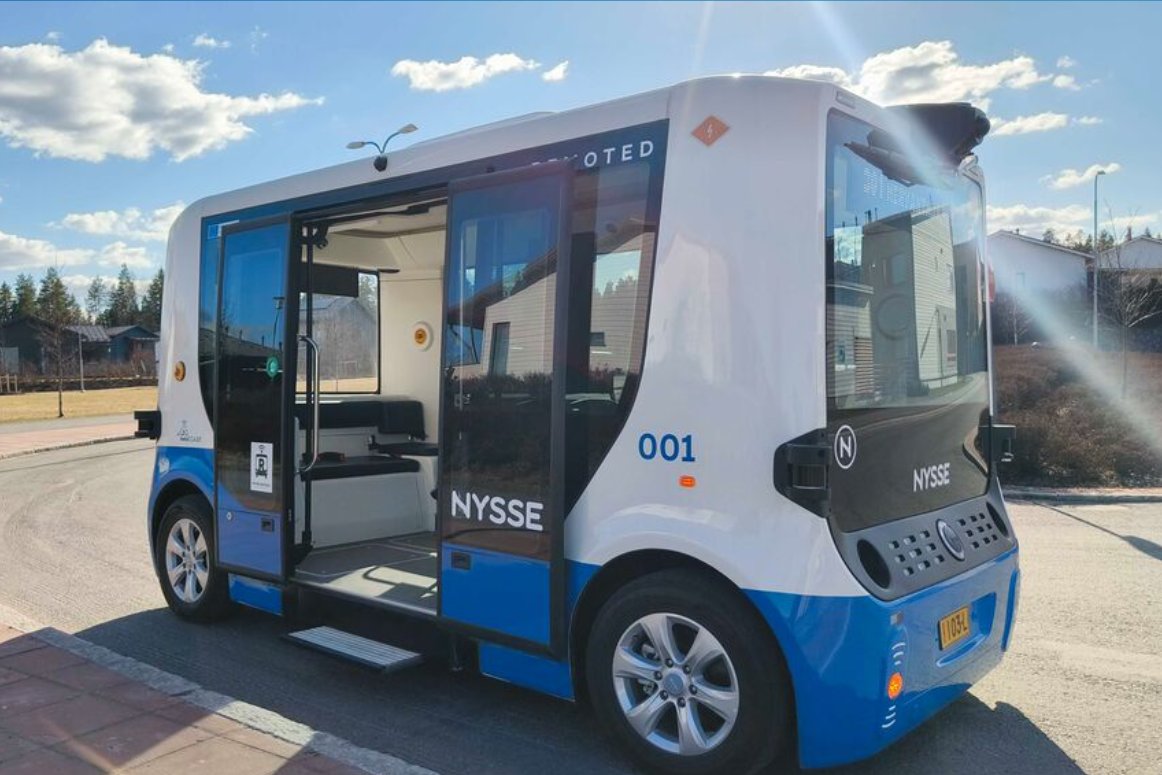
From the middle of this week, the vehicle will operate on route 301 between Hervantajärvi and Lintuhytti. While automated bus services have often been tested in pilot projects or on closed routes, the service in Tampere is part of the public transport network and is regularly available to passengers. The vehicle has been operating in normal traffic with a safety driver since November 2025. Following a successful test phase, it will now transition to fully autonomous operation without a driver on board.
The vehicle travels on a fixed route at low speed and continuously monitors its surroundings using various sensors. If the system detects obstacles or unusual situations, it can automatically stop. Despite operating without a driver, the bus is not left unattended. Specialists monitor operations in real time from a remote control centre and can intervene if necessary. The vehicle accommodates up to twelve passengers. Seatbelts must be worn during the journey, and passengers are required to remain seated.
The service is part of the EU-funded Metaccaze project. The city of Tampere and its transport operator Nysse are responsible for integrating it into the public transport system, including infrastructure and ticketing. The company Remoted handles remote monitoring and system management, while Tampere University provides scientific support for the project. Research focuses on aspects such as user acceptance and the operational efficiency of the automated service.
The southern Finnish city of Tampere is one of the demonstration municipalities for the project. One key objective is to relocate safety operators from the vehicles to central control rooms in the future, enabling the simultaneous monitoring of multiple automated vehicles. According to project partners, the existing fleet is set to expand with three additional autonomous vehicles.
Scandinavia as a pioneer in new mobility concepts
The deployment of the autonomous bus takes place in a market that is relatively open to new mobility concepts. In Finland, 48.8 per cent of all newly registered cars were fully electric in April. Even higher shares were achieved in Norway (98.6 per cent) and Denmark (81.9 per cent). The Nordic countries are thus considered key test markets for new technologies in electric and automated mobility.
Metaccaze is funded under the EU’s Horizon Europe research programme and tests electric, automated, and connected mobility solutions for passenger and freight transport in several European cities. Alongside Tampere, Amsterdam, Munich, and Limassol are among the so-called Trailblazer Cities, where the technologies are being tested under real-world conditions. The insights gained are intended to be shared with other European cities.