


South Korea’s auto behemoth Hyundai Motor Group is set to take its most decisive step yet toward commercial autonomous driving, as its US mobility joint venture Motional Inc. plans to launch a fully driverless robotaxi service in Las Vegas by the end of this year.
Laura Major, Motional’s chief executive, said last Friday that the company will deploy robotaxis capable of operating at Society of Automotive Engineers (SAE) Level 4, meaning the vehicles can handle most driving tasks without human intervention within defined areas.
The service will follow months of pilot operations throughout 2026 aimed at validating safety, customer experience and fleet management, with vehicle numbers scaled to meet local demand.
The announcement marks a milestone for Hyundai, which has invested nearly $3.4 billion in Motional since 2020.
After years of heavy spending and delayed commercialization, the Las Vegas rollout is expected to be the first real-world test of whether that investment can translate into deployable autonomous technology.
FROM COMMERCIAL LAUNCH TO GLOBAL ROADMAP
Motional selected Las Vegas as its first commercial market because of strong ride-hailing demand and the variety of driving environments, which allow rapid accumulation of real-world data.
It plans to begin pilot operations early this year in partnership with a global ride-hailing company, which will also work with Motional to commercialize the robotaxi service.
Major said Motional spent the past year refining its technology and operating model after previously slowing its rollout.
The pause, she said, was intended to build a system capable of scaling globally rather than rushing into limited deployment.
Once the Las Vegas service is operating reliably, Hyundai plans to review options for expanding robotaxi services into other regions, including South Korea, according to Kim Heung-soo, head of Hyundai Motor Group’s Global Strategy Office.

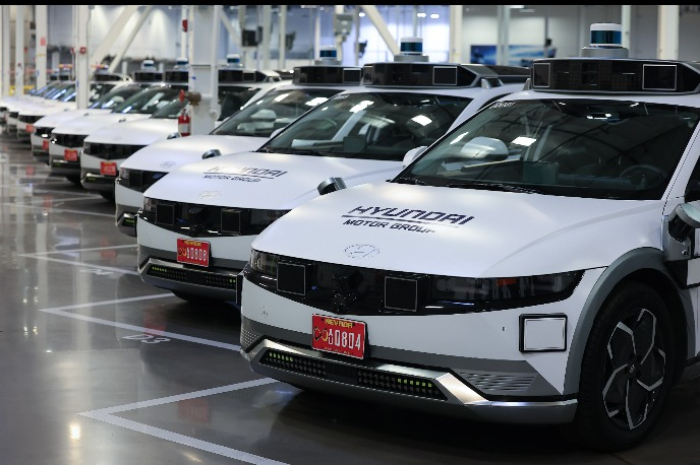
Robotaxies parked at Motional’s technical center in Las Vegas (Courtesy of Yonhap)
TECHNOLOGY DESIGNED FOR SCALE
Motional’s autonomous system combines traditional rule-based software with end-to-end artificial intelligence, a hybrid approach aimed at balancing safety validation with flexibility in complex or unusual driving scenarios, said Major.
The company is also integrating separate perception, prediction and planning models into a single large driving model to improve performance in edge cases.
The robotaxi fleet is built on Hyundai Motor Co.’s latest all-electric SUV, the IONIQ 5, which has received US federal vehicle safety certification for fully driverless operation, a rare regulatory milestone in the autonomous vehicle industry.
Hyundai plans to incorporate Motional’s autonomous driving expertise directly into its software-defined vehicle (SDV) roadmap led by 42dot, its in-house software unit, to strengthen groupwide autonomy capabilities.
“We are reviewing ways to combine our respective strengths, including data sharing and model integration,” said Yoo Ji-han, head of Hyundai Motor Group’s autonomous driving development center.
“Ultimately, we have a roadmap to integrate Level 4 autonomous driving technology at the group level.”
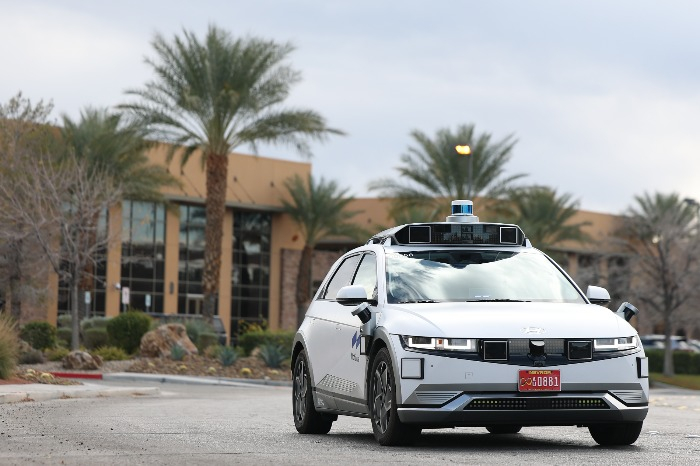
The IONIQ 5 robotaxi (Courtesy of Yonhap)
THE AUTONOMY BET COMES INTO FOCUS
Founded in 2020 as a joint venture with Aptiv PLC, Motional is now effectively controlled by Hyundai with a major stake in the company following additional capital injections and equity purchases.
The tighter ownership structure has given Hyundai greater control over technology direction and integration with its broader software-defined vehicle strategy.
By feeding robotaxi data, AI models and operational experience into its SDV architecture, Hyundai aims to shorten development timelines and reduce duplication of research spending across business units.
Hyundai’s software unit 42dot is also developing an in-house autonomous driving system known as Atria AI, which is scheduled to be applied to a software-defined vehicle “pace car” in the third quarter of this year, company officials said.
Hyundai will maintain close technical cooperation with Aptiv, leveraging its expertise in vehicle control systems as it continues to support Motional’s development, said Kim.