

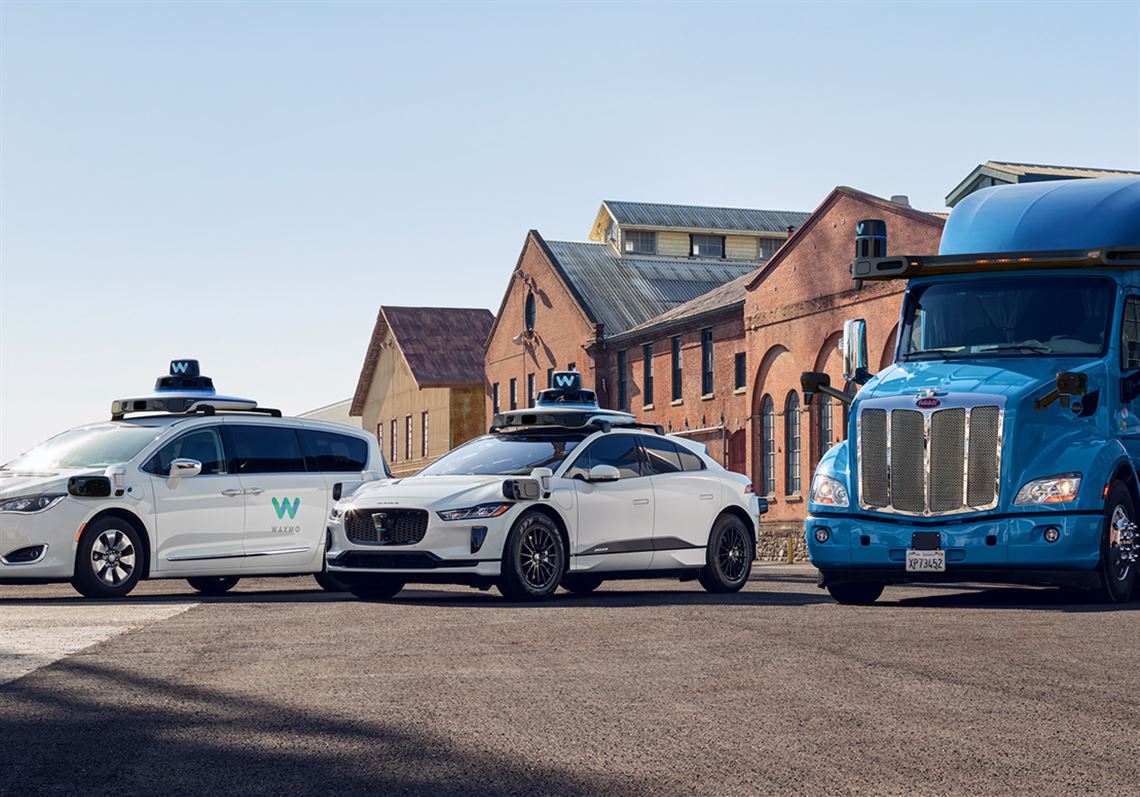
Waymo, the former Google self-driving car project, is opening an office in Pittsburgh.
It plans to collocate with Google’s local headquarters in Bakery Square and hire a team of about 20 workers to focus on its autonomous technology for moving people and goods. To kick off its new office, Waymo is bringing on expertise and employees from Shadyside-based RobotWits, which provides planning and decision making technologies for self-driving vehicles.
Waymo officials didn’t commit to bringing its autonomous trucks and cars to the city.
Tushar Chandra, a software engineer and head of behavior team at Waymo, said the company’s ambition is “to do more work in self-driving and to expand that service but this particular announcement is more about the office.”
Internally, Waymo has been thinking about Pittsburgh for quite some time, Mr. Chandra said, and just waiting to figure out how to make it happen. It wanted to be close to “world-class” talent in robotics, software engineering and autonomous vehicle technology.
“This is a very hard space technically, and what we focused on is building a world-class team so that we can build a really good autonomous vehicle,” he said. “So we want to have world-class talent, and of course Pittsburgh has world-class talent.”
In Bakery Square, Waymo is joining many of its competitors that have set up shop down the road in Lawrenceville and the Strip District, including Argo AI, Aurora and Motional.
The fact that so many companies working to solve the problem of self-driving technology are in Pittsburgh is “a reflection of where the talent is,” Mr. Chandra said.
Waymo’s Pittsburgh team will focus on both its autonomous projects: Waymo One for moving people and Waymo Via for moving goods.
The company started as the Google self-driving car project in 2009 with a goal to drive autonomously over 10 uninterrupted 100-mile routes in its Toyota Prius vehicles. By 2015, it had started fully autonomous rides on public roads, with the first in Austin, Texas.
It launched a commercial autonomous ride-hailing service in Phoenix in 2018. Today, anyone with the Waymo app in the Phoenix metro area can hail a fully autonomous ride, no driver included.
Waymo has tested autonomous vehicles in more than 25 U.S. cities. It has nine offices, including one in the United Kingdom and one in India.
In Pittsburgh, the company plans to hire about 20 people in the first six months and then ramp up, Mr. Chandra said. Some of those 20 people will include transplants from other Waymo offices who will help the team get off the ground. Others will come from RobotWits, a Shadyside tech company that Waymo is bringing on board.
RobotWits’ technology helps autonomous vehicles make decisions. For example, it helps a self-driving car decide how much it should turn the wheel, or whether it should pass a nearby car. It also helps with route planning and predicting what is happening around the vehicle with other cars and pedestrians.
“I am absolutely thrilled that the RobotWits team will be joining Waymo,” said founder and CEO Maxim Likhachev. “I am equally excited about the fact that this initiates Waymo’s presence in Pittsburgh, a city of robots that has vast research and development in robotics in general and autonomous vehicles in particular and produces massive engineering talent.”
Mr. Likhachev and two other employees from RobotWits will be joining the Waymo team, Mr. Chandra said.
Mr. Chandra could not disclose any financial details about the deal.
Waymo, a subsidiary of Alphabet, Google’s parent company, has about 2,000 employees, according to a spokesperson for Waymo.
It raised its first external investment round of $2.25 billion in March 2020. That round increased to $3.2 billion by the end of July 2020. This June, it announced another investment round of $2.5 billion.
Self-driving vehicles and autonomous technology were once considered a science problem, Mr. Chandra said.
But, as the industry advances with more testing and deployment of self-driving cars, particularly with Waymo’s driverless vehicles in Phoenix, it has transitioned from “what would be a nice science project to something that we’ve demonstrated can actually be done,” he said.
“Cars and trucks and other things are very central to modern civilization…and we think that with self-driving, things get a lot better in many ways,” Mr. Chandra said. “If this is just a dream, it’s a dream. But in fact now we think that the technology is caught up to that dream.”
Lauren Rosenblatt: lrosenblatt@post-gazette.com, 412-263-1565.
Source: www.post-gazette.com