

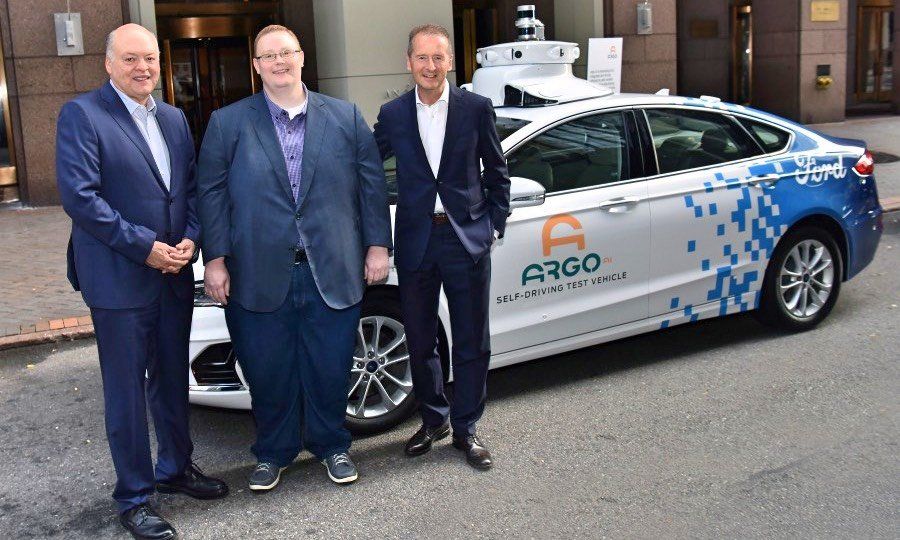
If the struggles of ride-share apps and their drivers are a regular part of your life as they are for so many people, Argo.AI is attempting to rid you of your annoying rideshare driver by developing technology that could make your Lyft vehicle drive itself.
The technology is so advanced, this Pittsburgh, Pennsylvania-based company attracted investment from one of the biggest rideshare companies in the world. But what’s the real story behind the company that’s seemingly almost ready to bring the dream of fully autonomous automobiles to the masses?
Like so many great American success stories, it all started with two young entrepreneurs with the skills to bring their ideas to life, and now the money to make it all happen. Service is expected to begin as early as 2022 in select cities, so let’s take a look at what we know so far.
If you absolutely can’t stand the ride-share experience, Argo.Ai is about to make things much more bearable. Let’s take a look at how.
Argo AI: Not The First Autonomous Vehicle Company, But Working To Be The Best.
For lots of commuters, the worst part of a ride-sharing service can be the person driving. Maybe they’re playing obnoxious club music from the early 2000s at a volume not suitable even for more tolerable forms of music. Maybe the smell from the afterward of their lunch is still sitting in the front passenger seat, or maybe they’re just plain rude.
Argo.Ai is a company that wants to give control to the ride-share customer by taking the driver out of the equation completely. How they do it is largely a collection of highly classified company secrets, but there are a few known facts about the company and its founders.
Argo.AI is the brainchild of founders Bryan Selesky and Peter Rander. Both men had prior experience in the Autonomous vehicle industry based on their work with Google (now known as Waymo) and Uber respectively. They’d go on to found Argo AI via undisclosed funding in 2016.
The company would then receive further funding from investments by Ford in 2018 and Volkswagen in 2020 to the tune of $1 billion dollars and $2.3 billion dollars respectively. The company’s board of directors consists of representatives from Ford, VW, and within Argo AI itself.
Innovative Technology Unlike Many Other Autonomous Vehicles
Unlike other self-driving systems like Tesla’s autopilot system which uses a series of cameras to determine spatial awareness and distance from other vehicles, Argo primarily uses a mix of LiDAR, and in-house developed software that constantly scans an image of the vehicle’s surrounding environment.
Using this technology, Argo Equipped Fords and Volkswagens would be able to compensate for road conditions and avoid unforeseen changes in traffic flow in enough time to maneuver the car out of danger or to avoid pedestrians.
In 2017, Argo acquired the Cranbury, New Jersey-based Princeton Lightwave, and much of their technology was integral in developing Argo’s top-notch Ai system. Such a system is classified as a level 4 self-driving system (SDS), the highest rating possible for an autonomous vehicle and ostensibly capable of limited use on public roadways.
Argo AI has conducted road tests with human backup drivers in dozens of cities across North America and parts of Europe. Including driving in adverse weather conditions like heavy rain, heavy snow, and heavy wind conditions.
Lyft Swoops In And Takes Things To The Next Level
Argo AI appears confident that the self-driving car of tomorrow we’ve been promised by science fiction is indeed possible. It’s a confidence that led the second-largest ride share service in the world to come knocking with a seemingly ready-to-write blank check for whatever Argo AI needed.
The news broke on the morning of July 21st that a small fleet of Ford Fusion Hybrids using Argo AI technology would hit the streets of Miami late this year, then expand to Austin, Texas by 2022.
Special alterations to the Lyft app in these cities will be implemented for customers to choose between a human this all comes after it Uber axed its own in-house autonomous vehicle program in December of 2020, sighting issues with safety and enormous cost overruns as the primary factors in its sale.
Now that Argo AI has the financial capital to finally bring a fleet of AVs to urban centers across America. So if you dread the thought of interacting with a stranger who blasts obnoxious music and refuses to change the station, your salvation might be at hand from a top-notch team of AI engineers.
Source: www.hotcars.com