

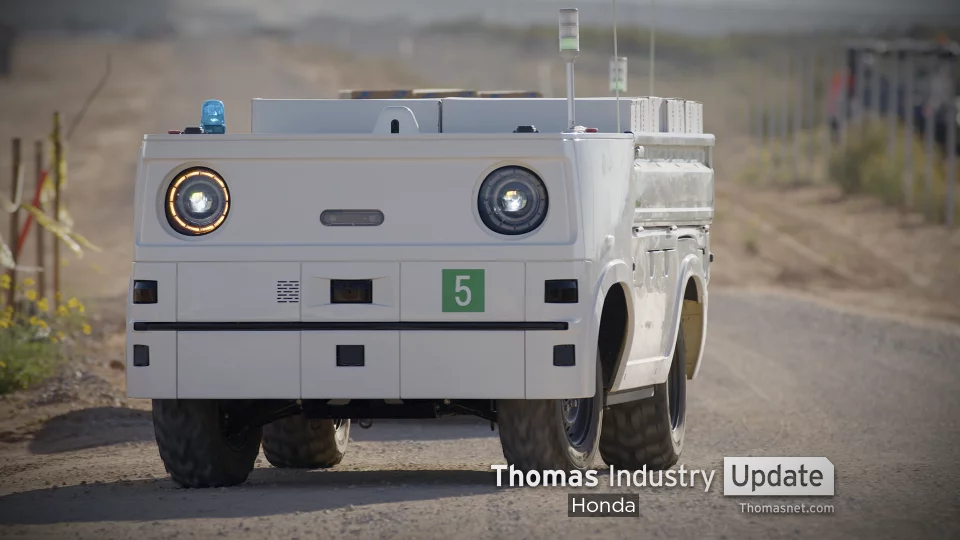
In 2018, Honda began testing Autonomous Work Vehicle prototypes in various situations, including search and rescue, construction, agriculture, and snow removal applications.
The first AVW resembled an agricultural, four-wheel drive quad bike. The main difference was that the top half was removed and sensors and self-driving equipment sat in its place.
The original’s autonomous capabilities allowed for “follow me,” “pattern,” or “A to B” modes as it moved materials, carried heavy equipment, sprayed crops, and conducted ground maintenance.
This month, Honda announced a successful test of the second-generation, fully electric prototype of the Honda AWV in New Mexico.
During its month-long field test, the AWV towed and transported supplies to pre-set destinations at a Black & Veatch solar energy construction site. Its payloads weighed approximately 900 pounds, and it also towed a trailer carrying over 1,600 pounds.
While delivering materials and supplies, the AWV displayed the ability to stop within centimeters of the pre-set points. It also proved its ability to support energy-intensive sensors and provide propulsion during eight-hour days in high temperatures.
New Atlas reports the new prototype features a “sawed-off, mini-truck feel.” Its appearance includes a pickup-style bed with sides and a tailgate that can be folded down. Two round headlights are in front, and a flashing blue light on top alerts workers to its whereabouts.
The new Honda AWV’s sensors use GPS for location, stereoscopic cameras for remote monitoring, and radar and lidar for detecting obstacles. It can also be operated via remote control.
Honda has yet to announce commercialization plans.
Image Credit: Honda
Source: www.thomasnet.com