 Moderation Team
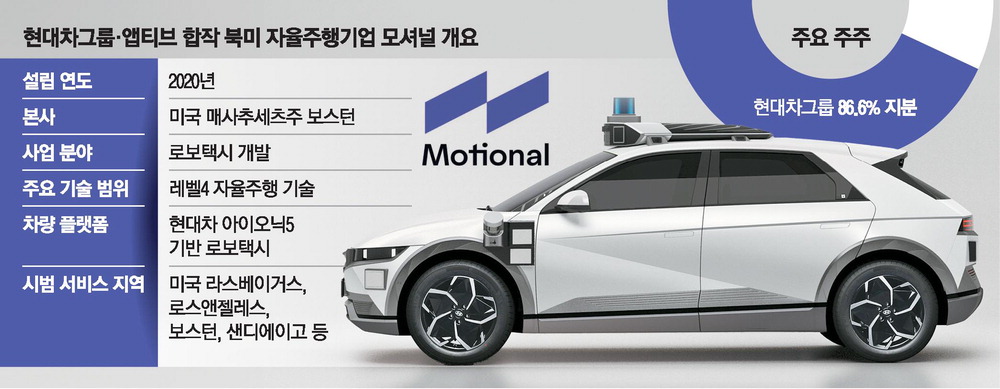
Hyundai Motor Group has challenged the global self-driving market by aiming for the launch of paid robotaxi services to 2026 through its North American self-driving subsidiary, Moral. Mural was launched in 2020 as a 50-50 joint venture between Hyundai Motor and Aptiv in 2019. Concerns were once raised over the past five years due to the widening deficit and stagnant technology, but Hyundai Motor has transfused funds through capital increase worth hundreds of billions of won in 2024 and 2025 and currently holds 86.6% stake.
According to the automobile industry on the 11th, if Mohnall achieves commercialization of autonomous driving in 2026, it is expected to change the game in the autonomous driving market dominated by big tech companies including Google Waymo and Tesla.
The global autonomous driving market is in the process of moving from the initial stage of technology development to the stage of commercialization implementation. As robo-taxi paid services are spreading mainly in the U.S. and China, and joint unions between finished vehicles and technology companies are accelerating, market reorganization is in full swing.
Currently, Waymo is virtually the only company in North America that provides completely unmanned commercial services. Waymo seems to be strengthening its technological edge by expanding its fully driverless vehicle operation in Phoenix, Los Angeles (LA), and San Francisco.
GM and Tesla have also announced their commercialization by raising their technology to a level close to commercialization. However, GM Cruise has not been in a recovery phase since it completely suspended its service in the aftermath of the accident. Tesla has formalized its transition to the robo-taxi business, but actual operations remain in their early stages.
Meanwhile, China is expanding its testing zone led by local governments and speeding up its urban commercial operations. Baidu ‘Apollo’ is accelerating data-based technology advancement by expanding unmanned robotaxi operations in Beijing and Wuhan. Europe has limited market spread due to many regulations.
Globally, autonomous driving technology is entering level 4 (high-altitude autonomous driving). Level 2 focuses on “driver assistance” functions such as lane keeping and speed control, and has already been applied to most finished cars. Level 3 is a stage where vehicles can drive on their own in some sections, but accident liability and insurance problems have not been resolved.
For this reason, Level 4, which allows people to move without riding in the city center, is becoming the “commercialization standard” of global companies.
Hyundai Motor expects synergy with future software-oriented vehicle (SDV) strategies based on level 4 autonomous driving technology owned by Mohnall and large-scale driving data accumulated in the actual city center. The autonomous driving industry believes that the core of the future autonomous driving competition is not just technology, but securing driving data, reducing vehicle and sensor costs, maintaining systems, and establishing stable business models. An official from the autonomous driving industry said, “Autonomous driving is no longer a stage of technology flaunting, but a process of moving to a business that makes money,” adding, “2025-2027 will be a turning point for commercialization of autonomous driving around the world.”
Meanwhile, attention is also being paid to the direction of the SDV technology project “XP2”, which was led by Song Chang-hyun, former head of Hyundai Motor’s Advanced Vehicle Platform (AVP). XP2 is a project designed as a core foundation platform for SDV transformation.
Inside Hyundai Motor, the prevailing view is that the project itself can be maintained, but the operation method can be adjusted. However, how to link the autonomous driving stack of Mional and SDV capabilities of Fortitudot is expected to be a watershed in software strategies in the future.
[Reporter Choo Donghoon]
GIPHY App Key not set. Please check settings