
 Moderation Team
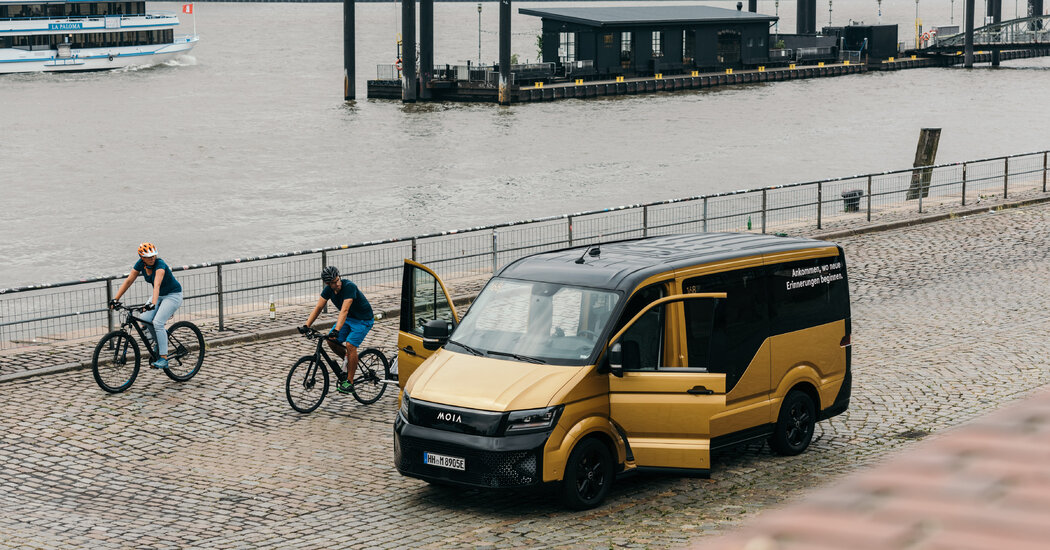
In Frankfurt-Hamburg, a fleet of electric Volkswagen Routs owned by a ride-hailing service roams the streets that carry and unload passengers. The vehicle is steered by itself, but technicians working in the remote control center monitor the progress with the help of a video monitor. If something goes wrong, they can control the vehicle and steer it out of trouble.
This futuristic vision is about to be legalized in Germany, within the bounds of current technology.Berlin parliament Approved new law on autonomous driving In May, it is waiting for the official signature of the German President. The law paves the way for companies to start making money from self-driving services, which could spur development.
Because self-driving cars need to be monitored by humans, German law states that researchers are years away from the car, so the driver can safely unload the car while the car is doing all the work. It reflects the perception that you can. The law also requires self-driving cars to operate in defined spaces approved by the authorities. This acknowledges that the technology has not advanced enough to function safely in areas where traffic is chaotic and unpredictable.
As a result, German companies pursuing this technology have adjusted their ambitions by focusing on money-making applications that do not require significant progress.
Germany’s national approach contrasts with the patchwork of US state law. The U.S. government has issued guidelines for self-driving cars, but with disagreements between automakers and self-driving developers on the content of the law, Congress attempts to establish mandatory rules that apply to all 50 states. Was founded in.
Some states encourage research into autonomous driving. In Arizona, for example, Waymo is enabling self-driving taxis in Phoenix. However, it is still impossible to deploy such services nationwide, and we have achieved a scale that will help make them profitable.
“Germany is unique in the sense that it has laws that affect the entire country,” said Elliott Katz, CEO of Phantom Auto, a California company that provides software to remotely monitor and control vehicles. I will. “In the United States, there are no comprehensive federal autonomous driving regulations. There are state laws, but driving is problematic because it is essentially an interstate highway.”
German law can also give national automakers an edge in the competition to design cars they can drive. Commercially deploying self-driving cars collects large amounts of data that can be used to advance technology. If the services are beneficial, they will also help you pay for further development.
“There are two main topics for German automakers: switching to electric vehicles and autonomous driving,” said Moritz Hüsch, a partner at the Covington law firm in Frankfurt, which complies with the law. “German carmakers are one of our best gems. They are really keen to be at the forefront of both topics.”
The law allows self-driving cars to stay within the defined territory and be monitored by trained technicians. The important thing is to allow the monitor to remotely monitor a large number of vehicles. This means that individuals or teams can monitor the fleet of autonomous shuttle vans or self-driving taxis with video from the command center, eliminating the need for all vehicle observers. In case of trouble, the technician can control the vehicle from a distance.
Proponents say the law allows autonomous buses to operate in areas where public transport is scarce. Other services may include automatic valet parking and robot courier services. Self-driving cars can be used to transport components and workers around the factory, or students around the university.
Vehicles that can navigate predictable courses, such as from airport parking lots to departure terminals, already exist, but existing German law requires humans to board, reducing costs by eliminating drivers. It is offset.
If the driver can monitor 12 buses from the command center, “there are now fascinating use cases,” said Peter Rigesmeier, director of the Fraunhofer Experimental Software Engineering Laboratory in Kaiserslautern. He said it would encourage further development.
In jargon, new legislation allows Level 4 autonomous driving. In most cases, this autonomous driving allows the vehicle to maneuver and navigate on its own, but may require human intervention. This is one step away from the nirvana of self-driving cars that can be driven without human help.
For example, Volkswagen is testing a ride-sharing service called Moia in Hamburg and Berlin. New legislation has made it easier for Volkswagen to reach its goal of converting Moia’s electric vans to autonomous driving by 2025, but it may also require further changes to national public transport legislation.
“Germany is now able to use self-driving cars,” said Christian Senger, senior vice president of commercial vehicles for Volkswagen’s self-driving cars, in a statement. “That’s what every market participant has been waiting for, not just Volkswagen.”
Technology companies like Waymo Or, automakers like Toyota have invested billions of dollars in self-driving technology, but there’s still no big return on their investment. Uber Last year, after investing over $ 1 billion, we sold our self-driving unit.Fatal crash involved Tesla autopilot Software is questioning the shortcomings of technology.
Whether a unified legal framework gives German companies a decisive advantage over American companies is another matter. That was the intention.
In a debate about the law in Berlin, Social Democratic MP Arno Klare said, “Germany could be the first country in the world to routinely use driverless vehicles from the lab. There is. “
In the United States, things get complicated as soon as self-driving cars try to cross state boundaries. California, Arizona, Michigan, and Pennsylvania are considered leaders in providing legal parameters for autonomous driving technology. However, 10 states, including New Jersey, Rhode Island, and Maryland, have not enacted legislation governing autonomous driving or issued executive orders. National Assembly of Parliament.. Rules in other states do not follow a consistent template.
Raj Rajkumar, who heads the autonomous driving program at Carnegie Mellon University in Pittsburgh, has produced many key scientists in the field, but said the new law would benefit German companies. But he said he was concerned that both the United States and Europe were at risk of lagging behind China in technology and regulation.
“There is an international arms race between the United States, Europe and China,” said Rajkumar, who estimates that fully autonomous vehicles are still ten years away. “China is an authoritarian country. They can pass any rule they want overnight.”
Source: eminetra.com

GIPHY App Key not set. Please check settings