
 Moderation Team
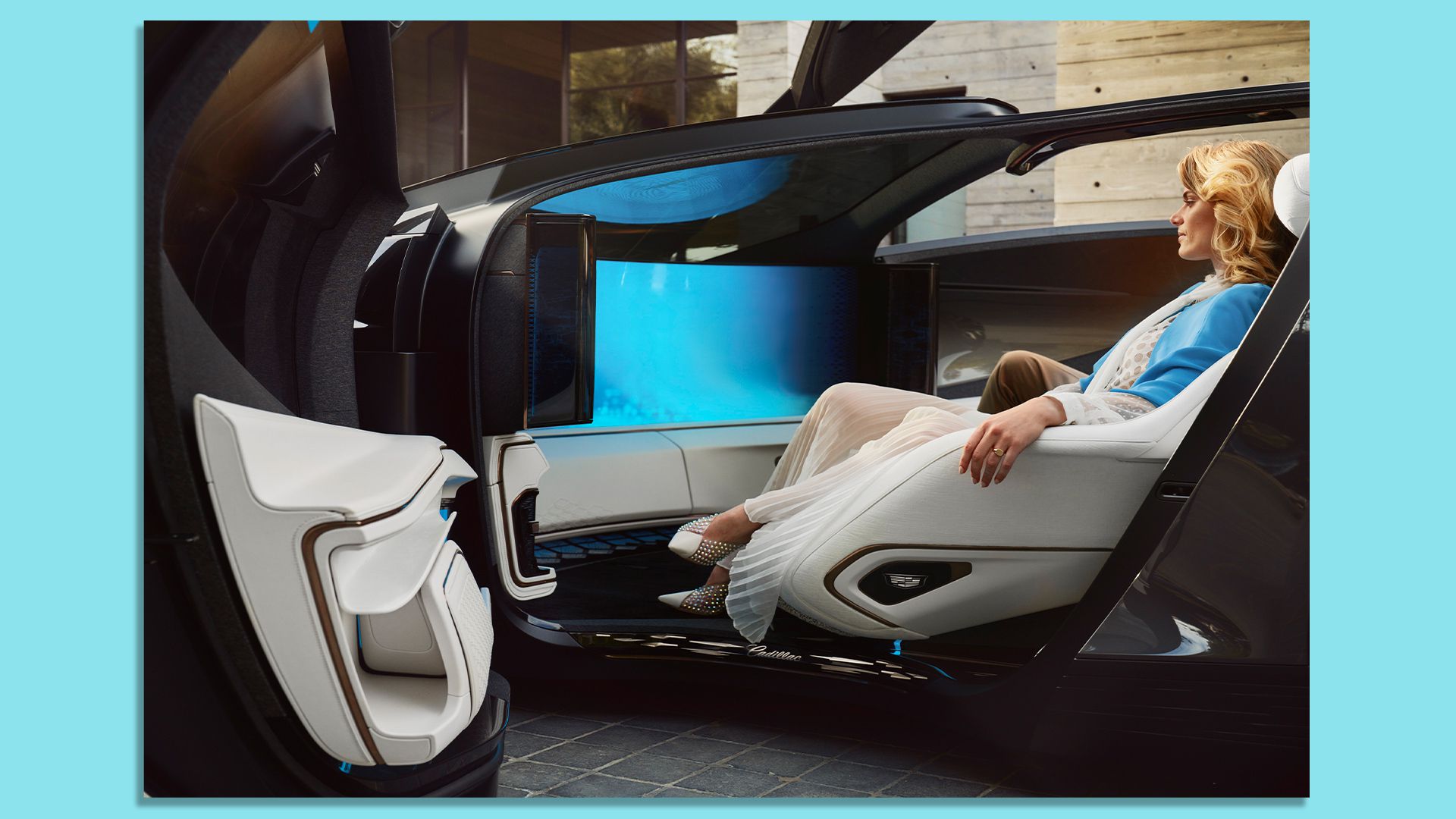
Image courtesy of Cadillac
GM designers envision a future where luxury car passengers, unencumbered by driving, can relax and enjoy the journey with experiences tailored to enhance their well-being.
Why it matters: The first autonomous vehicles for personal use could arrive “as soon as mid-decade,” according to General Motors — although some industry experts take issue with the claim. Whenever they arrive, self-driving cars promise to transform personal mobility.
- Mobility could be “an ally of wellness, giving customers the ultimate luxury — more personal time rather than taking it,” says Bryan Nesbitt, GM executive director for GM’ global advanced design and global architecture studio.
- Using biometric data and artificial intelligence, AVs will also be able to read passengers’ mood and personalize their journey.
The big picture: GM designers created a family of self-driving luxury concept vehicles to reflect their vision of mobility in 2030, including:
- the PersonalSpace — a single-seat aircraft for skipping above congested cities;
- the SocialSpace — a roomy, six-passenger party van;
- the InnerSpace — a sleek, two-seater focused on personal luxury.
I got an up-close look at these models during a rare visit to GM’s top-secret design dome in suburban Detroit last week.
- The PersonalSpace and the SocialSpace were unveiled — virtually, due to COVID-19 — at last year’s CES, the big technology show in Las Vegas.
- COVID interfered again with this year’s CES, when GM had planned a big splash for the InnerSpace.
- So this was the first chance to see the concepts in person.
Details: The InnerSpace coupe features a dramatically raked roof with panoramic glass that lifts upward, as the doors open and the seats rotate outward, for easier entry and exit.
- Instead of a steering wheel or traditional dashboard, the reclining love seat faces a huge wraparound LED screen.
- Passengers can choose entertainment, wellness recovery or augmented reality to enhance their journey, using their eye gaze or haptic controls concealed in the arm rests.
- Augmented reality layers points of interest and other details on the screen, giving passengers a more immersive experience, as if they’re floating down the road.
- Biometric sensors can detect the passengers’ heart rate and temperature to detect stress levels, responding with unique aromas, lights and sounds to enhance their well-being.
The bottom line: A lot of these features might never show up in a real car. But as I lay back, with my legs supported on the extendable footrest, blanket and slippers stowed nearby, I imagined a weekend trip with my husband in our self-driving car. And it was pretty chill.
Source: www.axios.com


GIPHY App Key not set. Please check settings