 Moderation Team
Summary: In May 2022, the NHTSA reported a 1% decrease in U.S. vehicle travel in 2021, yet traffic fatalities reached a record high of 42,900—a 10.5% increase from 2020. Investigations revealed that many trips were short, primarily to commercial areas, leading to increased accident risks. In response, the NHTSA launched a “National Road Safety” program, investing $6 billion to address the crisis. Simultaneously, autonomous driving gained momentum, with companies like Nuro, co-founded by Zhu Jiajun, securing substantial funding and evolving from unmanned delivery to tech licensing, although facing challenges in profit stability and strategic shifts.
In May 2022, the National Highway Traffic Safety Administration (NHTSA) of the United States released a set of puzzling data: The survey showed that in 2021, the total mileage of vehicle travel across the United States decreased by 1% compared to 33,000 miles in 2019. However, the number of people who died in traffic accidents in 2021 reached 42,900, setting the highest record since 2005. Meanwhile, the total number of deaths in 2021 increased by 10.5% compared to 2020, and this figure also set the highest increase since data recording began.
People drove less, but there were more accidents. What was going on?
Every life matters. Amid the huge public controversy, major institutions and relevant research teams quickly launched follow – up investigations and found the following data: In 2021, among the vehicle trips that could be counted across the United States, 52% of the trips were less than 3 miles, and 28% were less than 1 mile. At the same time, the proportion of long – distance trips over 50 kilometers was less than 1%. Further analysis of these short – distance trips revealed that most of them were to local commercial areas for shopping, entertainment, and gatherings. Especially for those who had established families, 88% of American families drove to large commercial areas at least once a week.
After sorting out a series of data, the answer gradually became clear: Although the demand for travel and tourism decreased under the influence of the pandemic, basic necessities and entertainment were always essential. This led to more and more vehicle trips concentrated in densely populated areas such as shopping malls and supermarkets. Coupled with the fact that people get tired, their eyes get fatigued, and their attention is often distracted, and the existence of the pandemic magnified this factor, the risk of traffic accidents increased exponentially.
So in that year, the NHTSA launched a “National Road Safety” program, which would invest up to $6 billion in five years for various tasks to reduce traffic accidents. Among them, $740 million would be used to invest in the improvement of relevant safety technologies. Steven Cliff, the then deputy administrator of the NHTSA, issued such an appeal: “We are facing an imminent crisis in our transportation, which requires the participation of everyone – local governments, automobile manufacturers, and drivers.”
It was also in that year that autonomous driving, which had fewer “human factors” and seemed more convenient for big – data management, welcomed an unprecedented period of dividends: For example, Cruise, an autonomous driving unicorn, completed its last external financing before being acquired in 2022. SoftBank sold its shares to General Motors, and its valuation exceeded $30 billion. For example, Waymo, an autonomous driving project incubated by Google for more than 10 years, launched a manned trial operation in 2022 and officially obtained a taxi operation license in Los Angeles at the end of the year.
In this revolutionary wave of entrepreneurship, there was also the figure of a young Chinese man. The company he founded, Nuro, had become a super – unicorn in the field of autonomous driving. At its peak in 2021, its valuation reached as high as $8.6 billion (approximately RMB 61.435 billion). Recently, he also secured the support of Uber and Nvidia and successfully completed a Series E financing, raising $203 million in this round (approximately RMB 1.45 billion). Including this amount, Nuro has raised a total of $2.3 billion (approximately RMB 16.4 billion) since its establishment.
From a top student at Fudan to a genius in Silicon Valley
This young Chinese man who seized the opportunity was Zhu Jiajun, a very “typical” Chinese – American elite in Silicon Valley:
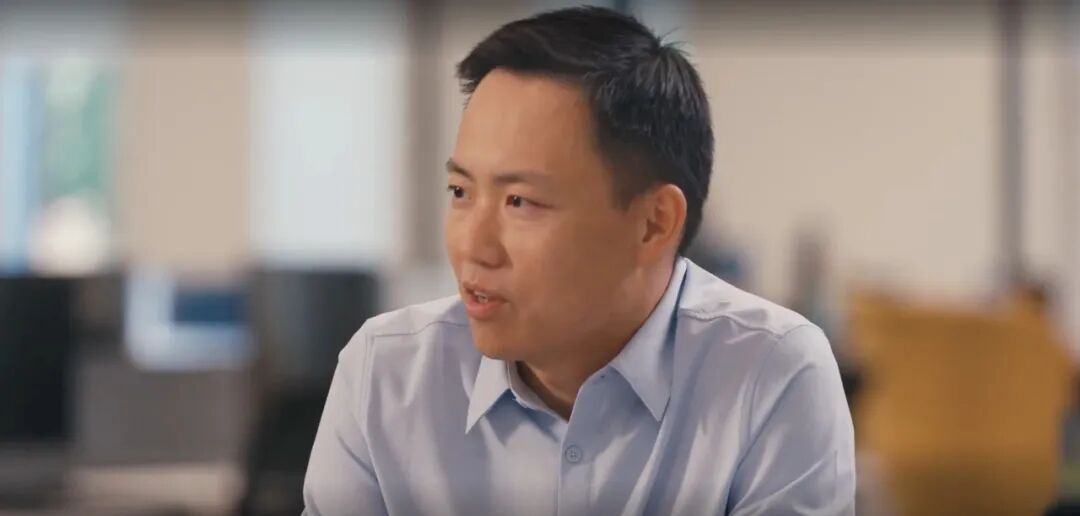
Zhu Jiajun. Source: Nuro official website
Zhu Jiajun received very good “skill training” from an early age. He started learning art at the age of 7 and won the first prize in an outdoor sketching competition in Shanghai and the second prize in a national oil – painting competition. After entering middle school, he showed his talent in mathematics and physics. He regarded the legendary scientist Nikola Tesla, the inventor of alternating current, as his idol and wrote a program to “draw function graphs” to help him with his homework. After graduating from high school, he was admitted to the Department of Computer Science at Fudan University as he wished and began to fully realize his potential. In his junior year, he developed a music – collaboration software and won the second place in the China region of the Microsoft Imagine Cup Global Student Software Competition. He also got an internship opportunity at the Microsoft Research Institute.
From a chronological perspective, Zhu Jiajun’s entrepreneurial story was also a typical struggle history of a Silicon Valley elite:
After graduating from undergraduate studies, Zhu Jiajun went to the University of Virginia to pursue a master’s degree in computer science. During his studies, he actively participated in various academic exchange activities and encountered a turning point in his life. While attending SIGGRAPH (an academic forum for computer graphics and interactive technology), he was so fascinated by the Google booth that he couldn’t leave. This successfully piqued the curiosity of Luc Vincent, the founder of the Google Street View team and one of the Google exhibitors.
Zhu Jiajun told Luc that his research topic was “restoring the location and 3D structure of buildings in a photo through analysis.” Luc told Zhu Jiajun that his research direction was in line with the needs of Google Street View. However, Google Street View was not only satisfied with presenting a “3D world” but would also venture into a field called “artificial intelligence” in the future to make the world presented by Google Street View more intelligent and vivid. “If you’re interested, you can come to Google after graduation. Here’s my business card.”
Three months later, after completing his thesis defense, Zhu Jiajun sent an email to Luc and successfully got an internship opportunity at Google. On the first day of the internship, Luc gave Zhu Jiajun all the key data of Google Street View and told him, “Do everything on your own. There are no specific tasks.”
Then, just like all legendary entrepreneurial stories, a good mentor recognized a talented person. Luc’s full trust brought unexpected surprises. Zhu Jiajun developed a plugin called “click – to – go” in three weeks, which greatly improved the user experience of Google Street View. Before that, users couldn’t use Google Street View to take a “cyber walk” and couldn’t move from one street view to another. They could only choose the forward direction through a given arrow in the software, which was very rigid. With “click – to – go”, any point in the picture could become the starting or ending point.
This plugin completely impressed Luc, and the internship offer was directly converted into a job offer. After careful consideration, Zhu Jiajun accepted Luc’s invitation, gave up his graduate courses at the University of Virginia, and officially joined Google, working at the Google X Lab.
At the X Lab, Zhu Jiajun could access many cutting – edge projects, such as Project Glass (smart glasses) and Self – Driving Car (autonomous driving cars). He was responsible for the technical development of the “perception” part and led a simulation team called “Crystal ball”. Later, it was this team that wrote the first – version perception system for Google’s autonomous driving project, Waymo. Zhu Jiajun also became one of the core five – member group when Waymo was established.
At the X Lab, there was another team responsible for the development of vision, prediction, and scene – understanding technologies, called “Magic”. The person in charge was Dave Ferguson. At the beginning of Waymo, he also became a member of the core five – member group, undertook a large number of development tasks, and became good friends with Zhu Jiajun. This was also the starting point of Nuro’s entrepreneurial story:
In 2016, after successfully developing “the world’s first fully autonomous driving car on public roads”, Google decided to spin off the autonomous driving project and established an independent entity under its parent company, Alphabet, named Waymo. During the structural adjustment, they gave core members like Zhu Jiajun and Dave two options: either sign an eight – year labor contract with Waymo and continue to lead the team, or take a severance package and leave the team to seek other opportunities.
Both Zhu Jiajun and Dave chose the latter, and they each received a “severance package” of $40 million. A few weeks later, this money became the startup capital for their entrepreneurship, and Nuro was officially established. It was said that the name came from the Arabic word “Nur”, which meant “angelic light”. I thought this statement was highly credible because the slogan on the Nuro official website also expressed this meaning: “Let everyone, every road, and every journey enjoy autonomous driving“.
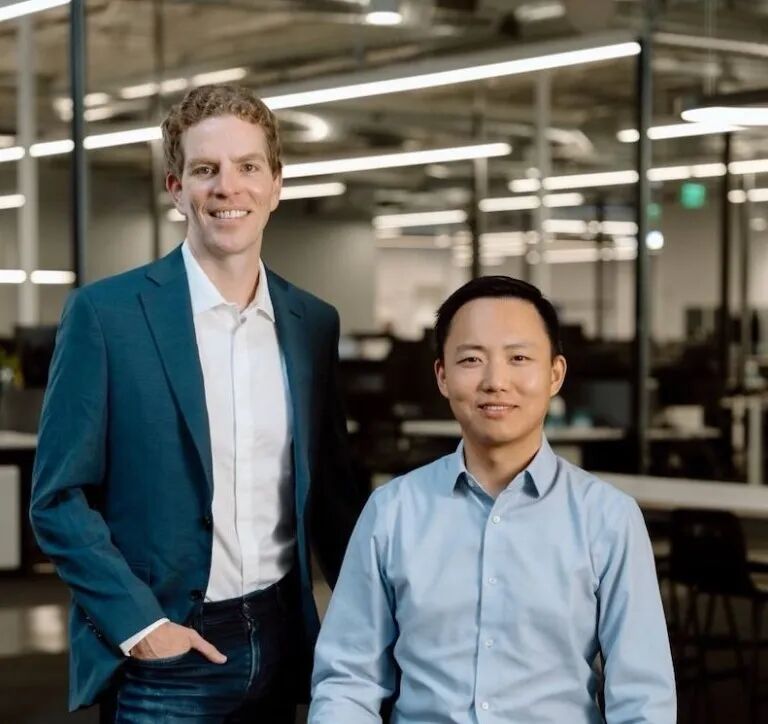
(Dave and Zhu Jiajun. Image source: Social media of Zhu Jiajun)
From unmanned delivery to autonomous driving
Zhu Jiajun’s personal growth story was like a popular novel, and Nuro’s growth path also seemed similar. Since its establishment in 2016, it has never lacked support from the capital market:
In 2018, Nuro completed its first – round financing, raising a total of $92 million. The investors were the well – known Greylock and Gao Rong Capital. In 2019, SoftBank became a new investor in Nuro, with an investment of $940 million. Thus, Nuro crossed the unicorn threshold in just three years, and its valuation reached $2.7 billion. In 2020, Nuro completed a Series C financing led by T. Rowe Price Group, and its valuation skyrocketed to $5 billion. In 2021, Nuro completed a Series D financing led by Tiger Global Management. Google, the former employer of Zhu Jiajun and Dave, also became an investor, and the valuation reached $8.6 billion.
However, such figures easily made people overlook the twists and turns in Nuro’s development process:
Perhaps to find the Product – Market Fit or due to the lessons learned during the Waymo period, Zhu Jiajun and Dave chose a very differentiated product route after starting their business – unmanned logistics delivery.
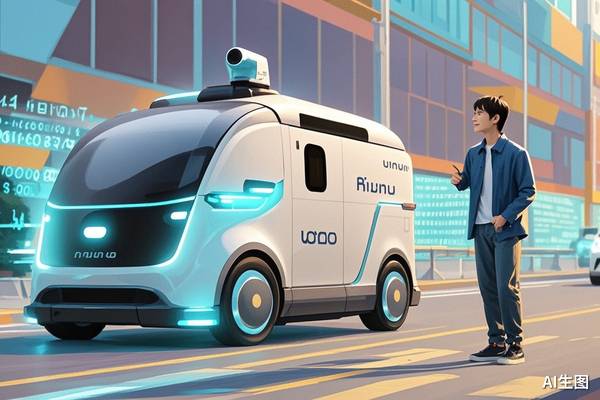
Take their star product, the third – generation unmanned freight vehicle “Nuro”, which had the same name as the company, as an example. In terms of appearance, Nuro was a van with a camera on top. Its payload was 500 pounds (about 400 catties), and its maximum speed was 45 miles per hour (about 70 kilometers per hour). The internal compartments could maintain a constant temperature between – 40°C and 20°C, and the on – board computer could adapt to the external environment at any time to control energy consumption. For safety reasons, Nuro was also equipped with an external airbag to ensure the safety of pedestrians.
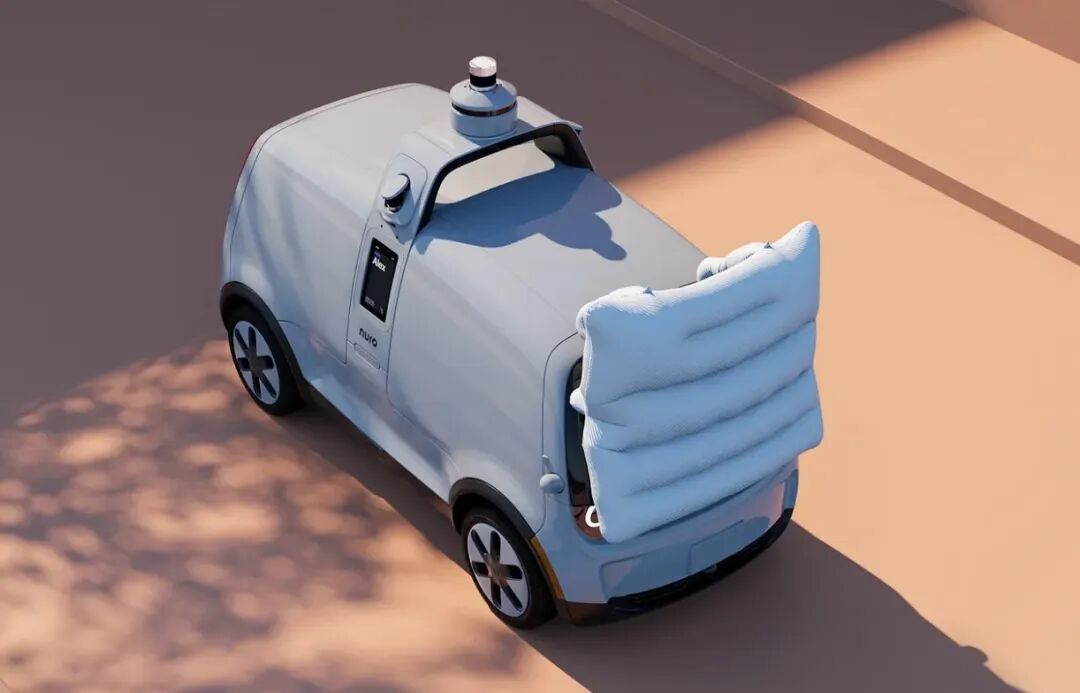
(External airbag. Source: Nuro official website)
Everything seemed perfect, and the market scenario was also very realistic. However, the problem was that building a car had costs, and Zhu Jiajun and Dave were idealists.
The combination of these two things determined Nuro’s initial development route: They not only developed their own autonomous driving software but also built their own cars. When they released their first product, R1, in January 2018, some media wrote: “Nuro took a different path in the field of autonomous driving. Instead of installing an autonomous driving plugin on a Ford Focus, it built a brand – new car from scratch… Although it looked like a toaster on wheels at first glance.”
A considerable part of Nuro’s early financing was also invested in “car – building”. For example, in 2020, Nuro fully acquired Ike, a developer of autonomous trucks. Ike’s valuation at that time was $250 million. Among many autonomous truck companies, their advantage lay in truck system solutions, motion planning, and simulation. In August 2021, they also announced that they would invest $40 million to build an automobile production line and a testing ground for autonomous driving performance in Nevada, the United States.
As for the result, it could only be said that “battle reports can deceive, but the front line won’t”. When Nuro officially started road testing, they honestly chose the Toyota Prius as the vehicle.
On the other hand, not only did building a car have costs, but using a car also had costs. It was quite difficult to convince customers to abandon the traditional logistics thinking of “manual labor” and switch to the “surreal” logistics tool they provided. In terms of business, although they had reached cooperation agreements with well – known retail chains in the United States such as Kroger, well – known pizza brands like Domino’s, and well – known convenience stores like 7 – Eleven, most of these cooperations were regional or even street – level.
Affected by several factors, Nuro actually never found a stable profit model. Finally, in November 2022 and May 2023, Nuro laid off 300 and 340 employees respectively. While trying to survive by making tough decisions, it temporarily suspended its original product development plan and changed its entire strategic direction, gradually shifting from pursuing the production of complete vehicles to a technology licensing model focused on pure R & D.
In other words, compared with when it was first established in 2016, Nuro was already a brand – new company on a second – stage entrepreneurial journey. This also explained why Nuro’s valuation dropped from $8.6 billion in 2021 to $6 billion in this financing, as the fundamentals of the valuation had completely changed.
The new investors introduced in this financing also reflected the strategic shift to some extent. Nuro’s Series E financing was carried out in two stages. The first stage was completed in April this year, and the main investors were mostly financial investors, including T. Rowe Price Group, Fidelity Capital, Tiger Global Management, and Greylock, with a total investment of $106 million. In the second stage not long ago, the investors they introduced were mostly industrial capital, including Nvidia, Uber, Kindred Ventures, an early investor in Uber, and Baillie Gifford, a well – known “ultra – long – term investor” in Horizon.
According to reports, the cooperation between Nvidia and Nuro was based on their long – term in – depth cooperation. Currently, Nuro used Nvidia’s GPUs on a large scale for data processing and model training, and its latest computing model was also built on the Nvidia Drive AGX Thor platform. The reason why Uber chose Nuro was that it had invested in an autonomous driving car manufacturer, Lucid, and planned to produce at least 20,000 Gravity SUVs for operation within six years. Nuro provided an important “brain” for this car. Dave said that the cooperation negotiation between the two parties had lasted for a whole year. “Currently, the engineers of Lucid and Nuro have made substantial progress.”
Of course, no one knew what the “substantial” progress actually meant. According to Uber’s plan, the Gravity SUV would not be officially launched into the market until after 2026. Even Dave himself admitted that Uber had “contacted almost all software developers in the market” before finalizing the cooperation, which seemed like a playboy spreading his net widely. Considering the current industrial manufacturing capabilities in the United States and the long – standing habit of product delays in the American manufacturing industry, there were full of uncertainties.

GIPHY App Key not set. Please check settings