 Moderation Team
Nissan’s ProPilot Driver Assist is ready, are you?
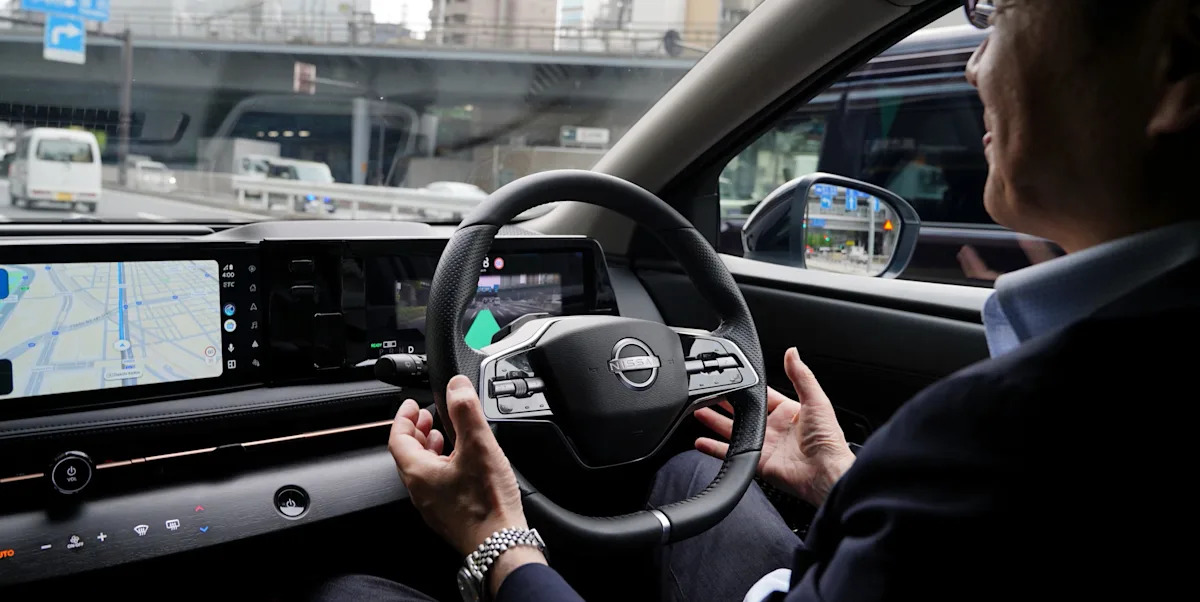
We got a short ride through a busy part of Tokyo in a Nissan Ariya electric car equipped with Nissan’s Next-gen ProPilot Powered by AI and must say, it is smooth and competent. Maybe even smoother than Mercedes-Benz’s MB.Drive Assist Pro. So the future might be here.
Problem is, as with most things in the future, you’ll have to wait for it. Nissan says the consumer version of ProPilot is coming in “fiscal year 2027,” which could be as late as March of 2028, or whenever a fiscal year ends, though no more specific date was given.
Nonetheless, it’s an impressive program. I got a ride in one through the streets of Tokyo with ProPilot’s executive chief engineer Tetsuya Iijima in the driver’s seat. He didn’t have to do anything, not even hold the wheel or keep his eyes forward. From start to finish on what was maybe a 10-mile loop through city streets, he didn’t touch the wheel or the pedals. So he had plenty of time to talk, even keeping his eyes on me while he spoke instead of keeping them on the road. So in that regard, ProPilot is way ahead of Ford’s BlueCruise and GM’s Super Cruise.
Mercedes’ Drive Pilot, the world’s first SAE Level 3 autonomous system, allows hands-off, eyes-off driving at under 40 mph on specific roadways that have stop-and-go traffic clogging them up. But it’s listed as a Level 3 system, and Mercedes takes legal responsibility for the car’s actions when it’s engaged.
Iijima said they have not decided yet whether they will require that drivers keep their hands on the wheel or eyes on the road, though government restrictions and the insurance industry may dictate that. It’d be a pity to have a system that works as well as Level 4 autonomy be hamstrung by the liability requirements of a Level 2 system and have to keep a hand on the wheel at all times.
“The AI (used in ProPilot) is equal to or better than the human brain,” Iijima said. “We believe this is Level 4. However, Level 4 is a social definition. This system has capability of level 4.”
“The system comprehensively understands all relevant information, anticipates what will happen next and the impact of its actions, delivering a heightened level of safe, predictable driving like a skilled human driver,” said Takashi Yosizawa, corporate executive of Nissan’s Software Defined Vehicle Engineering Division.
Nissan says its new ProPilot’s AI Partner Technology “seamlessly integrates vehicle, cloud, and third-party data to provide support that matches the driver’s intent.” It can understand interactions and conversations, update the route in real time if needed, and set the drive mode depending on road conditions. It can even share information about points of interest as you pass them.

The new ProPilot never faltered on our drive.Nissan
(Nissan)
While the current ProPilot 2.0 and 2.1 could commandeer the car, accelerate, brake, and change lanes, this new system goes beyond that. Next-Gen ProPilot Powered by AI can handle door-to-door drives for you. Among its talents, Nissan says it can:
-
Manage vehicle control in complex intersections
-
Manage driving on private roads
-
Anticipate traffic lane congestion
-
Protect pedestrians and cyclists
It doesn’t require any special maps, it can run on anything you feed into it. Ours was Google Maps.
“Google Maps, Apple Maps or TomTom, any map as long as a human can read it. Any map is okay,” said Iijima.
We were driven at a regular pace through the city, waiting till it was clear to make a turn across traffic, and waiting for pedestrians to clear crosswalks. The Nissan setup seemed less hesitant than other existing systems, it drove more like a human.
It wasn’t aggressive, though. Does it take into consideration drivers in, say, Boston, who are all crazy? Or Japanese drivers who tend to be very polite? How does it distinguish?
“Basically, we don’t separate the data between regions,” Iijima said.
The system uses cameras at lower speeds in the city, as we were doing, but at higher speeds, it incorporates the LIDAR.
Then, while it was driving almost directly into the sun, a bicyclist in front of us veered around a large garbage bin that stuck out into traffic. The car slowed down and allowed the cyclist to go around the obstacle, then sped up again to pass. Not bad.
It won’t go into the oncoming lane to pass, even if it’s clear, unless the center stripe is broken, indicating it’s okay to cross it. Likewise, it won’t break the speed limit. But at any time you can step on the gas, override the system, and go as fast as you want.
Usually these new systems debut on expensive cars and then work their way down the product line. Is that going to be the case here?
“We hope this system enhances traffic safety, so we try to make it as affordable as possible. That’s our approach,” said Iijima, without quoting a price.
While it may be available on a wider range of models, it will be offered as an option.
So all we have to do now is wait until sometime in fiscal year 2027/28. But every other carmaker in the world is working on this stuff, too, and other systems may be out by then, which may indicate why we got this early look. It’s all good for the buyer. More choice. See you in 2028!

GIPHY App Key not set. Please check settings