 Moderation Team
Like many autonomous vehicle companies, Boston-based Optimus Ride paused its autonomous operations at customer sites due to COVID-19. The MIT spin-off is doing its part to observe social distancing and help contain the spread of the novel coronavirus.
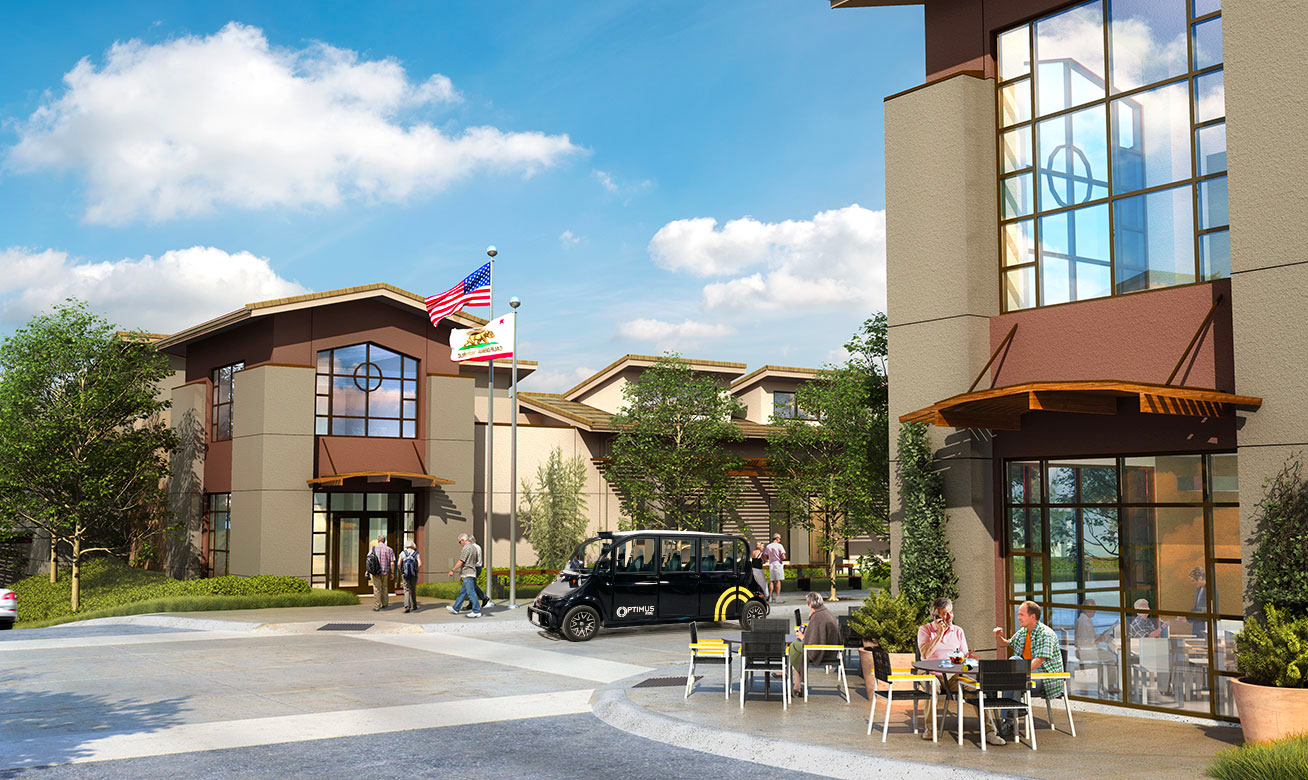
One of the places it paused operations was at Paradise Valley Estates (PVE), a retirement community for people ages 55-plus in Fairfield, Calif. Optimus Ride offers a point-to-point service for PVE residents within the gated community. The service was moving from Alpha to Beta phase, according to Optimus Ride’s Q4 2019 Progress Report. The service was initially offered to a select user group, but it is being opened to the greater PVE community, with operating hours from Monday-Saturday from 12PM-8PM PST, with modified and/or extended service hours during holidays and special events.
But after the pausing of operations, PVE management asked Optimus Ride to help with evening meal delivery. PVE residents are no longer allowed to congregate in the dining hall, so PVE is using the autonomous shuttles to bring meals directly to them. The shuttles are being driven manually, delivering between 50-80 meals per day.
Optimus Ride said PVE residents have showed appreciation by leaving handwritten notes, cards, signs, and teddy bears. “It is responses like these that have made our team feel our work is more meaningful than ever, and we will continue with our meal deliveries for PVE while the situation is still ongoing,” said Optimus Ride.
Optimus Ride could transport medical personnel
The city of Boston has also approached Optimus Ride for help. Boston is home to some of the best medical facilities in the world, and the city is seeking mobility alternatives for its medical workers fighting COVID-19. Optimus Ride said it has worked with the city numerous times, even before the formation of Optimus Ride, when MIT advised the city on how to create a self-driving “Zone” to enable companies to test and commercialize self-driving systems.
“We are still in the early stages of developing COVID-19 mobility plans with the City of Boston, and are not able to speak to specifics of routes, mapping or testing at this time,” an Optimus Ride spokesperson told The Robot Report. “That said, Optimus Ride has some of the most sophisticated self-driving vehicle technology in the world and we are confident our vehicles could offer valuable support during the COVID-19 crisis, as we have seen in our efforts at Paradise Valley.
Its all-electric shuttles move at slow speeds, maxing out at 25 MPH. Using three Velodyne LiDAR sensors (two in the front, one in back) and eight cameras, the shuttles can in real time detect people and objects around its vehicles, as well as calculate the speed and trajectory of those objects. With that information, the vehicle’s on-board computer system determines how to drive to its destination.
In addition to PVE, the shuttles were running in Boston’s Seaport District, the Brooklyn Navy Yard and Brookfield Properties’ Halley Rise development in Reston, Va.
Optimus Ride raffled off autonomous shuttle rides at the Robotics Summit & Expo 2019, which is produced by The Robot Report. It raised an $18 million Series A round in November 2017 that was led by Greycroft Partners. Other participating investors included Emerson Collective, Fraser McCombs Capital, and MIT Media Lab director Joi Ito. Then in April 2019 it raised another $20.7 million in a prospective $60 million round.
“Self-driving technology systems have a historic opportunity to address mobility and logistical issues both during and after the pandemic,” said the company. “While the vast majority of the general population is in work-from-home mode, the list of essential personnel during a pandemic is long. It includes personnel from healthcare/public health/human services, law enforcement, public safety, first responders, food and agriculture, energy, waste and wastewater, transportation and logistics, public works, communications and information technology, critical manufacturing, hazardous materials, financial services, chemical, defense industrial base, and other community-based essential functions and government operations. Thus, it is critical for self-driving technology companies to accelerate development of their systems.”
Source: www.therobotreport.com

GIPHY App Key not set. Please check settings