
 Moderation Team
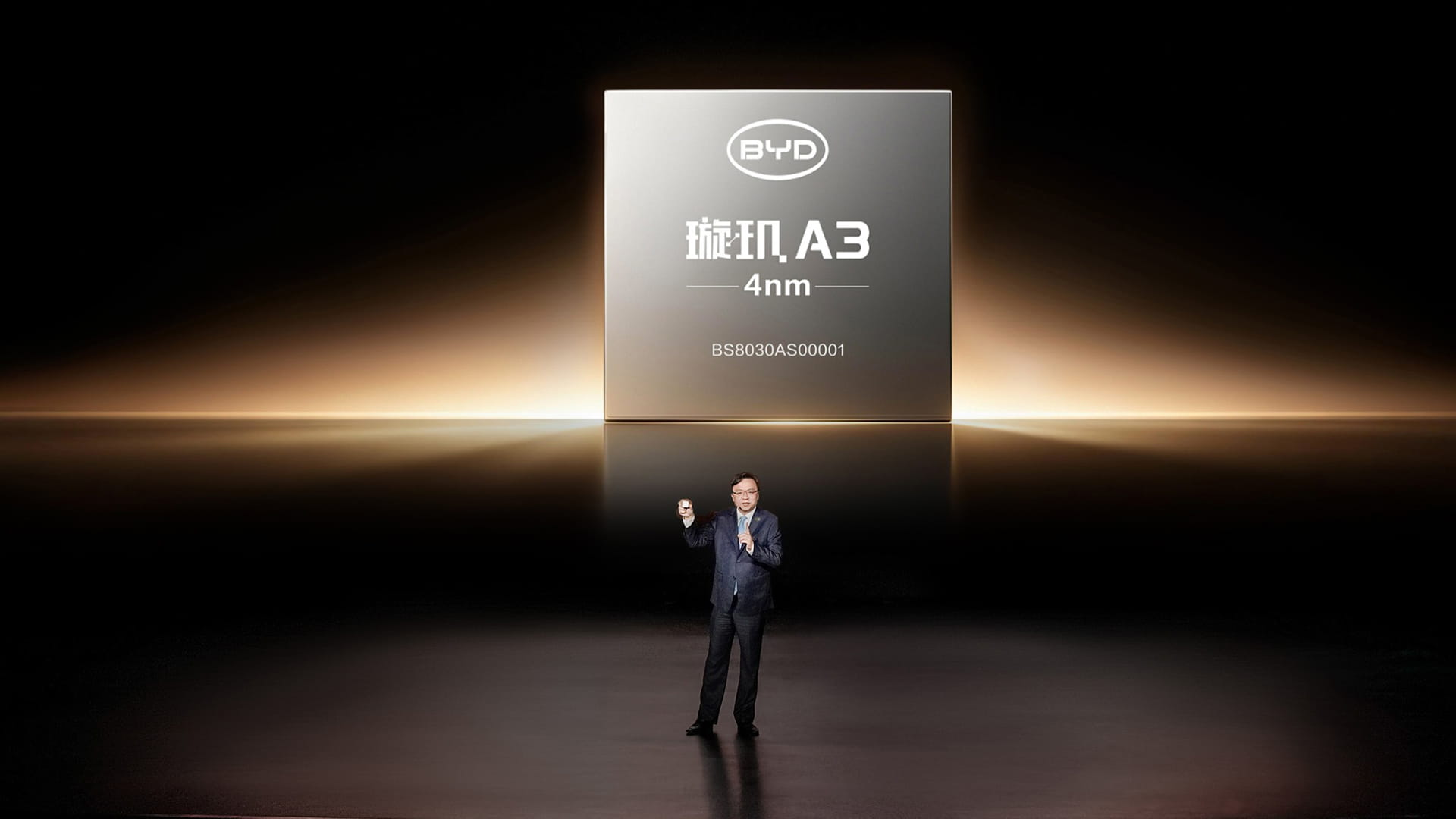
BYD’s announcement that it will produce its own cutting-edge four-nanometer chips for autonomous driving was met with a muted initial response from investors, a sign that the Chinese electric vehicle leader must do more to dispel concerns over growth.
The electric vehicle giant’s Hong Kong-listed shares were trading up around 2% on May 29, dipping around 1% at one point, while shares in Horizon Robotics, one of BYD’s automotive chip suppliers, plunged nearly 10% at one point. Rival chip developer Black Sesame saw its stock price fall as much as 5%.
“We expect BYD’s share price inflection point could be from around mid-end June with likely improved visibility on … earnings and new businesses,” Citi analysts wrote in a research note on May 29. BYD’s net income more than halved in the January-March period, marking a fourth consecutive quarterly profit drop.
Looking to reverse an eight-month streak of falling sales, the Shenzhen-based carmaker announced on May 28 the release of a semiconductor that supports Level 3 to Level 4 autonomous driving—technologies not yet approved for mass adoption by Chinese authorities.
The so-called Xuanji A3 semiconductor could deliver computing power of 2,100 TOPS (tera operations per second) in a three-chip cluster, according to BYD. That is roughly as powerful as other self-driving chips recently released by local rivals, but still behind Nvidia’s flagship Thor X.
BYD founder and chairman Wang Chuanfu held the new chip in his hands as he introduced it at a press event on May 28, saying his company is the first automaker in the world to boast all the capabilities needed for chip manufacturing, from design to wafer fabrication and testing.
“The breakthrough means that we are able to provide all the chips required in an intelligent vehicle, and as much computing power as we need in the future,” Wang said, referring to the company’s long-standing vertically integrated structure in which it manufactures everything from general automotive chips to batteries.
Chinese EV makers have been ramping up efforts in recent years to design self-driving and artificial intelligence chips in-house, as such advanced processors are increasingly needed to support sophisticated features commonly found on software-defined cars.
Xpeng, Nio, and Li Auto have adopted self-designed autonomous driving chips in their premium models while working with contract semiconductor manufacturers to produce the chips. The trio are currently using 5-nm chip production processes.
Products built by homegrown chipmakers such as Huawei, Horizon Robotics, and Black Sesame have also gained popularity among Chinese automotive companies, thanks to their lower prices and stronger data security assurances compared with offerings from Nvidia and Qualcomm.
The Ministry of Industry and Information Technology—China’s top automotive regulator—has set a target for domestic carmakers to use 100% self-developed and manufactured chips for some models by 2027, Nikkei Asia reported last year.
BYD is fundamentally an automaker for the mass market, with its costs spread across a large number of models. Its latest chip move is expected to boost sales, as it means even the company’s low-priced models will also be equipped with cutting-edge driver assistance functions.
Citi analysts estimate that the Xuanji A3 chip will help lower the total assisted driving hardware cost to as low as roughly one-third of Nvidia Thor-based solutions, which will ease cost pressure on models priced between RMB 80,000–300,000 (USD 11,776.1–44,160.5).
However, industry insiders and investors remain skeptical about whether the Xuanji A3 chip could deliver the performance BYD has promised, and whether the move makes commercial sense.
As a formidable player in China’s EV sector, BYD is unlikely to find external clients for its self-driving chips. The company said it has invested more than RMB 100 billion (USD 14.7 billion) into its automotive chip ambitions since its inception, and has vowed to plow another RMB 100 billion (USD 14.7 billion) into intelligent technology R&D over the next three years.
An executive from a Chinese car chip maker, who asked not to be named, expects BYD’s 4-nm chips will mainly be for in-house use, as most companies would still entrust the manufacturing of such advanced chips to Taiwan Semiconductor Manufacturing Company (TSMC), due to its high stability and yield rate.
In comparison, Xpeng has integrated its self-designed Turing chip into select models launched by Volkswagen, which owns a 5% stake in the Guangzhou-based EV maker. Xpeng has also been in discussions to supply the chip to rival automakers.
Other innovations unveiled by BYD on May 28 include an in-vehicle AI agent and an upgraded assisted driving system. The group also introduced a one-year warranty for its so-called God’s Eye self-driving solution, pledging to compensate buyers for any economic losses caused by traffic accidents while specific functions are activated.
“The company achieves sharp hardware cost reduction, upgraded user experience, and comprehensive liability protection,” Citi analysts wrote. “These moves will reshape the competitive landscape and create disruptive pressure on leading Chinese EV startups.”
The God’s Eye system mostly uses chips supplied by Nvidia for higher-priced models and Horizon Robotics for lower-priced ones.
Citi analysts expected luxury cars sold under BYD’s Yangwang and Denza sub-brands to retain Nvidia’s flagship chips.
This article first appeared on Nikkei Asia. It has been republished here as part of 36Kr’s ongoing partnership with Nikkei.
Note: RMB figures are converted to USD at rates of RMB 6.79 = USD 1 based on estimates as of June 8, 2026, unless otherwise stated. USD conversions are presented for ease of reference and may not fully match prevailing exchange rates.


GIPHY App Key not set. Please check settings