
 Moderation Team
Automotive AI Market: Artificial Intelligence is Revolutionizing the Global Automotive Industry
Artificial intelligence is rapidly transforming the automotive industry from traditional mechanical engineering into a software-driven ecosystem. Once limited to research laboratories and concept vehicles, AI is now powering intelligent features such as Advanced Driver Assistance Systems (ADAS), autonomous driving, predictive maintenance, voice assistants, driver monitoring systems, and connected vehicle platforms.
As automotive manufacturers continue investing in electrification, connectivity, and automation, AI has become one of the most critical technologies shaping the future of mobility. Modern vehicles increasingly rely on machine learning, computer vision, deep learning, and sensor fusion to process massive volumes of real-time data, enabling safer driving experiences and enhanced operational efficiency.
This shift is reflected in the strong growth outlook for the Global Automotive AI Market, which is projected to expand significantly over the next decade as automakers accelerate investments in intelligent transportation technologies.
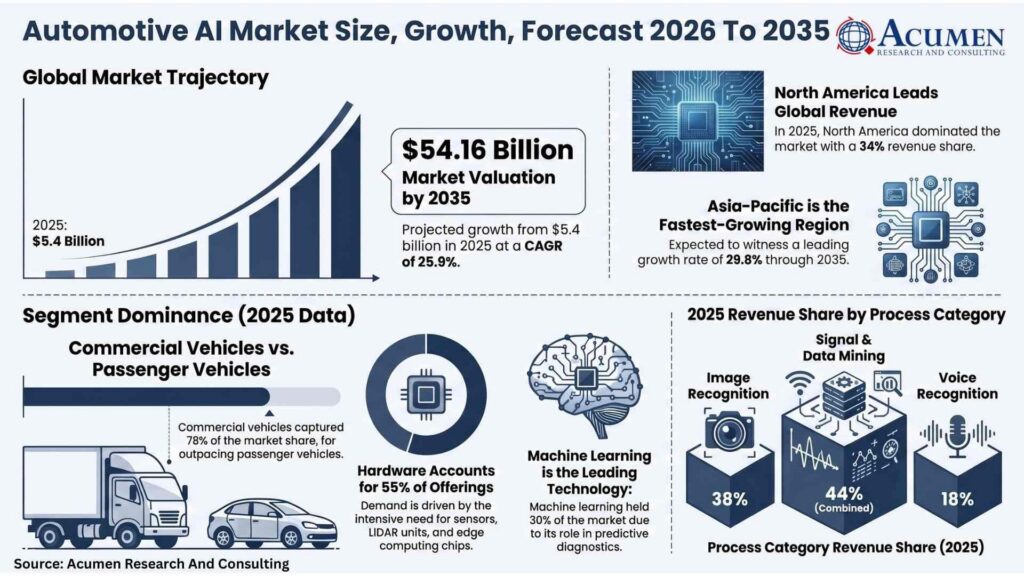
Automotive AI Market Snapshot – Acumen Research And Consulting
| Market Attribute | Details |
|---|---|
| Automotive AI Market Size (2025) | USD 5.40 Billion |
| Automotive AI Market Forecast Value (2035) | USD 54.16 Billion |
| Automotive AI Market CAGR (2026–2035) | 26.0% |
| Largest Regional Market | North America (34% share in 2025) |
| Fastest Growing Region | Asia-Pacific (29.8% CAGR) |
| Forecast Period | 2026–2035 |
Key Takeaways
- The global Automotive AI Market is expected to grow nearly tenfold between 2025 and 2035.
- Artificial intelligence is becoming a core technology for autonomous vehicles and connected mobility.
- Advanced Driver Assistance Systems (ADAS) remain one of the largest application areas.
- Software-defined vehicles are accelerating AI adoption across passenger and commercial vehicles.
- North America continues to lead the market, while Asia-Pacific is emerging as the fastest-growing region.
- Investments in edge AI, computer vision, and intelligent sensors are reshaping automotive innovation.
What is Automotive Artificial Intelligence?
Automotive Artificial Intelligence refers to the integration of AI technologies into vehicles and transportation systems to enable intelligent decision-making, automation, and real-time data processing. Unlike conventional automotive software that operates on predefined rules, AI systems continuously learn from data, recognize patterns, and improve performance over time.
These capabilities enable vehicles to interpret road conditions, detect obstacles, recognize pedestrians, optimize navigation routes, monitor driver behavior, and even anticipate maintenance requirements before failures occur.
Today, AI is embedded across nearly every aspect of modern vehicle development—from manufacturing and quality control to advanced safety systems and autonomous driving.
Automotive AI Market Size and Growth Outlook
According to Acumen Research And Consulting, the Global Automotive AI Market was valued at USD 5.40 billion in 2025 and is projected to reach USD 54.16 billion by 2035, growing at a robust CAGR of 26.0% during the forecast period.
This remarkable growth reflects the automotive industry’s transition toward intelligent, software-defined vehicles capable of delivering enhanced safety, improved efficiency, and personalized user experiences.
Several factors are contributing to this expansion, including:
- Rising demand for autonomous driving technologies.
- Rapid adoption of Advanced Driver Assistance Systems (ADAS).
- Increasing deployment of connected vehicle platforms.
- Growing investments in electric and software-defined vehicles.
- Advancements in AI chipsets, computer vision, and sensor technologies.
- Expansion of smart transportation infrastructure.
As governments introduce stricter vehicle safety regulations and consumers increasingly demand advanced in-car technologies, AI is expected to become a standard feature across both premium and mass-market vehicles.
Major Trends Driving the Automotive AI Market
1. Rise of Software-Defined Vehicles
The automotive industry is moving toward software-defined vehicles, where software rather than hardware determines functionality and enables continuous improvement through over-the-air updates.
Artificial intelligence plays a central role in this transformation by supporting intelligent vehicle management, predictive diagnostics, and personalized driving experiences.
2. Expansion of Advanced Driver Assistance Systems (ADAS)
ADAS technologies continue to be one of the strongest growth drivers for Automotive AI.
Features such as adaptive cruise control, automatic emergency braking, lane departure warning, blind-spot detection, traffic sign recognition, and driver monitoring systems increasingly rely on AI algorithms capable of interpreting complex road environments in real time.
As regulatory bodies worldwide introduce stricter vehicle safety standards, automakers are expanding ADAS deployment across a broader range of vehicle models.
3. Growing Investment in Autonomous Vehicles
Self-driving technology remains one of the most influential trends shaping the Automotive AI Market.
Autonomous vehicles depend on artificial intelligence to integrate information from cameras, LiDAR, radar, ultrasonic sensors, GPS, and high-definition maps.
Machine learning models continuously analyze these data streams to make real-time driving decisions, improving navigation, obstacle avoidance, and passenger safety.
Although fully autonomous vehicles are still evolving, significant investments by automotive manufacturers and technology companies continue to accelerate innovation.
4. Edge AI is Improving Vehicle Intelligence
Traditional AI systems relied heavily on cloud computing for data processing. However, modern vehicles increasingly incorporate edge AI, enabling data to be processed directly inside the vehicle.
This approach offers several advantages:
- Lower latency
- Faster decision-making
- Enhanced cybersecurity
- Reduced bandwidth requirements
- Improved operational reliability
Edge AI is expected to become increasingly important as connected and autonomous vehicles generate enormous volumes of sensor data.
Automotive AI Market Dynamics
Market Driver: Increasing Demand for Intelligent Mobility
Consumers today expect vehicles to deliver more than transportation—they seek intelligent, connected, and personalized mobility experiences.
Artificial intelligence enables vehicles to offer:
- Predictive navigation
- Voice-controlled infotainment
- Driver fatigue detection
- Intelligent parking assistance
- Predictive maintenance alerts
- Personalized cabin settings
As digital experiences become a key differentiator in vehicle purchasing decisions, automakers continue investing heavily in AI-powered innovations.
Market Restraint: High Development Costs and Technical Complexity
Despite significant growth opportunities, implementing automotive AI remains a complex undertaking.
Developing reliable AI systems requires advanced semiconductor hardware, high-performance computing, extensive data collection, and rigorous validation to meet automotive safety standards.
Cybersecurity concerns, regulatory compliance, and the high cost of AI-enabled components also present challenges for manufacturers seeking large-scale deployment.
Automotive AI Market Segmentation Analysis
The Automotive AI Market is evolving rapidly as automakers integrate artificial intelligence across vehicle design, manufacturing, safety systems, and connected mobility platforms. AI adoption varies across technologies, applications, and vehicle types, with each segment contributing to the industry’s long-term transformation.
By Technology
Machine Learning Leads AI Innovation
Machine learning is one of the foundational technologies driving the Automotive AI Market. It enables vehicles to continuously learn from historical and real-time data, improving decision-making without requiring manual programming.
Automotive manufacturers use machine learning to enhance predictive maintenance, optimize energy consumption in electric vehicles, improve navigation systems, and support autonomous driving capabilities. As data volumes continue to grow, machine learning algorithms are expected to become increasingly sophisticated, enabling safer and more efficient vehicle operations.
Computer Vision Powers Intelligent Driving
Computer vision has become indispensable for advanced vehicle perception systems. AI-powered cameras process visual information to detect pedestrians, recognize traffic signs, identify lane markings, and monitor surrounding traffic conditions.
Combined with radar, LiDAR, and ultrasonic sensors, computer vision enables vehicles to interpret complex road environments with remarkable accuracy. This technology forms the backbone of many Advanced Driver Assistance Systems (ADAS) and autonomous driving platforms.
Natural Language Processing Enhances User Experience
Natural Language Processing (NLP) is transforming how drivers interact with vehicles. AI-powered voice assistants can understand spoken commands, provide navigation assistance, control infotainment systems, and personalize in-car experiences.
As conversational AI continues to improve, voice-enabled interfaces are expected to replace many traditional dashboard controls, contributing to safer and more intuitive driving experiences.
By Vehicle Type
Passenger Vehicles Dominate Market Demand
Passenger vehicles account for a significant share of AI adoption due to rising consumer demand for intelligent safety features and connected mobility solutions.
Premium vehicle manufacturers initially pioneered AI integration, but many advanced features—including adaptive cruise control, automated parking assistance, and intelligent navigation—are now becoming available in mid-range vehicles.
Growing consumer awareness regarding vehicle safety and convenience is expected to drive continued adoption across the passenger vehicle segment.
Commercial Vehicles Embrace AI for Fleet Optimization
Commercial vehicle operators increasingly deploy AI technologies to improve fleet management, logistics efficiency, and operational safety.
AI-powered systems help fleet operators:
- Optimize fuel consumption
- Predict maintenance requirements
- Monitor driver behavior
- Improve route planning
- Reduce vehicle downtime
- Enhance cargo security
As logistics companies continue embracing digital transformation, AI will become a critical component of intelligent fleet operations.
Key Applications of Automotive AI
Artificial intelligence is transforming virtually every aspect of modern vehicle functionality.
Advanced Driver Assistance Systems (ADAS)
ADAS remains the largest application area for automotive AI.
AI algorithms process data collected from cameras, radar, LiDAR, and ultrasonic sensors to support features such as:
- Automatic Emergency Braking (AEB)
- Adaptive Cruise Control (ACC)
- Lane Keeping Assist
- Traffic Sign Recognition
- Blind Spot Monitoring
- Driver Attention Monitoring
- Intelligent Parking Assistance
These technologies enhance driver safety while reducing accident risks and supporting the gradual transition toward autonomous mobility.
Autonomous Driving
Autonomous vehicles rely heavily on AI to perceive surroundings, interpret traffic scenarios, and make real-time driving decisions.
Deep learning models continuously process enormous amounts of sensor data to identify obstacles, predict the behavior of other road users, and determine optimal driving actions.
Although fully autonomous vehicles remain under development, AI continues to advance the capabilities of semi-autonomous driving systems available today.
Predictive Maintenance
Predictive maintenance has emerged as one of the most practical AI applications within the automotive industry.
By analyzing engine performance, vibration patterns, battery health, and other operational parameters, AI systems can identify potential failures before they occur. This allows vehicle owners and fleet operators to schedule maintenance proactively, reducing downtime and repair costs.
Manufacturing and Quality Inspection
AI is also revolutionizing automotive manufacturing.
Manufacturers use AI-powered robotics, computer vision, and predictive analytics to automate production lines, detect defects, improve quality control, and optimize supply chain operations.
Smart factories equipped with AI technologies are achieving higher productivity while reducing waste and manufacturing costs.
Automotive AI Market Regional Analysis
North America Leads Global Adoption
North America accounted for 34% of the global Automotive AI Market revenue in 2025, making it the largest regional market.
Several factors contribute to the region’s leadership:
- Significant investments in autonomous driving technologies
- Strong presence of automotive OEMs and AI technology companies
- Advanced semiconductor ecosystem
- High adoption of connected vehicles
- Government support for intelligent transportation systems
The United States continues to serve as a major hub for automotive AI innovation, with technology companies and vehicle manufacturers collaborating to develop next-generation mobility solutions.
Asia-Pacific Emerges as the Fastest-Growing Market
Asia-Pacific is projected to expand at a CAGR of 29.8% through 2035, making it the fastest-growing regional market.
Rapid growth is supported by:
- Expanding vehicle production
- Rising electric vehicle adoption
- Increasing AI investments
- Government initiatives promoting smart mobility
- Growth of semiconductor manufacturing
- Rising demand for connected vehicles
China, Japan, South Korea, and India are expected to remain key contributors to regional market growth due to their strong automotive manufacturing ecosystems and increasing investment in AI research.
Europe Strengthens Intelligent Mobility
Europe continues to make significant progress in automotive AI through investments in electric mobility, autonomous vehicle testing, and connected transportation infrastructure.
The region’s emphasis on sustainability, road safety, and digital transformation is encouraging automakers to integrate advanced AI capabilities into future vehicle platforms.
Automotive AI Market Competitive Landscape
Competition within the Automotive AI Market is intensifying as automotive manufacturers, semiconductor companies, and software providers invest heavily in artificial intelligence.
Leading market participants are focusing on:
- AI-powered perception systems
- Edge AI processors
- Autonomous driving software
- Intelligent cockpit solutions
- Advanced sensor fusion
- AI-based cybersecurity
- Over-the-air software update platforms
Strategic partnerships between automotive OEMs and AI technology companies are accelerating innovation while reducing product development timelines.
Companies are also investing heavily in research and development to improve AI model accuracy, reduce computational requirements, and enhance vehicle safety.
Emerging Technologies Shaping the Future
Several emerging technologies are expected to redefine the Automotive AI Market over the next decade:
Edge AI Computing
Processing AI workloads directly within the vehicle enables faster decision-making, lower latency, and improved data privacy.
AI-Optimized Semiconductor Chips
Specialized AI processors are delivering higher computing performance while reducing energy consumption, supporting increasingly complex vehicle applications.
Digital Twins
Automakers are using digital twin technology to simulate vehicle performance, improve product development, and optimize manufacturing processes.
Vehicle-to-Everything (V2X) Communication
AI combined with V2X technology allows vehicles to communicate with other vehicles, road infrastructure, and traffic management systems, enhancing road safety and traffic efficiency.
Future Outlook: Automotive AI Will Define the Next Generation of Mobility
Artificial intelligence is no longer an emerging technology in the automotive industry—it is becoming the foundation of next-generation mobility. Over the next decade, AI is expected to influence nearly every stage of the automotive value chain, from vehicle design and manufacturing to driving, maintenance, fleet management, and customer engagement.
As automakers continue transitioning toward software-defined vehicles, AI-powered systems will become increasingly sophisticated. Future vehicles will not only respond to driver commands but also anticipate user preferences, optimize driving behavior, monitor vehicle health in real time, and communicate seamlessly with surrounding infrastructure.
The continued advancement of electric vehicles (EVs), connected cars, autonomous driving, and Vehicle-to-Everything (V2X) communication will further strengthen the role of AI in shaping intelligent transportation ecosystems.
Growing investments in AI chipsets, cloud computing, edge computing, digital twins, and intelligent sensors are expected to unlock new opportunities across passenger vehicles, commercial fleets, logistics, ride-sharing, and public transportation.
With supportive government regulations, increasing consumer acceptance of advanced safety technologies, and rapid digital transformation across the automotive sector, the Automotive AI Market is well-positioned for sustained long-term growth through 2035.
Analyst Perspective
The Automotive AI Market is transitioning from feature-based innovation to platform-based intelligence. Initially, AI was deployed primarily to enhance individual vehicle functions such as navigation or parking assistance. Today, it is becoming the central intelligence layer that integrates perception, decision-making, connectivity, cybersecurity, and vehicle management.
One of the most significant trends shaping the industry is the evolution of software-defined vehicles. Unlike traditional automobiles that rely heavily on hardware upgrades, software-defined vehicles can continuously improve through over-the-air (OTA) updates, enabling manufacturers to introduce new AI-powered capabilities long after a vehicle has been sold.
The convergence of AI with electrification, cloud computing, high-performance semiconductors, and advanced sensor technologies is expected to create substantial opportunities for automakers, technology companies, semiconductor manufacturers, and mobility service providers. Organizations that prioritize scalable AI architectures, robust cybersecurity, and seamless user experiences are likely to gain a competitive advantage in the years ahead.
Artificial intelligence is fundamentally reshaping the automotive industry by enabling safer, smarter, and more connected vehicles. From advanced driver assistance systems and predictive maintenance to autonomous driving and intelligent manufacturing, AI is driving innovation across every stage of the automotive ecosystem.
According to Acumen Research and Consulting, the global Automotive AI Market is projected to grow from USD 5.40 billion in 2025 to USD 54.16 billion by 2035, registering a CAGR of 26.0%. This remarkable growth reflects increasing investments in autonomous mobility, connected vehicles, intelligent transportation infrastructure, and AI-powered software platforms.
As the industry continues its transformation toward digital mobility, artificial intelligence will remain a cornerstone technology, creating new opportunities for innovation, operational efficiency, and enhanced customer experiences worldwide.
Frequently Asked Questions (FAQs)
1. What is the Automotive AI Market?
The Automotive AI Market encompasses artificial intelligence technologies integrated into vehicles and automotive systems to improve safety, automation, connectivity, navigation, predictive maintenance, manufacturing, and the overall driving experience.
2. How large is the Automotive AI Market?
According to Acumen Research and Consulting, the Automotive AI Market was valued at USD 5.40 billion in 2025 and is projected to reach USD 54.16 billion by 2035, growing at a CAGR of 26.0% during the forecast period.
3. What is driving the growth of the Automotive AI Market?
Key growth drivers include increasing adoption of Advanced Driver Assistance Systems (ADAS), connected vehicles, autonomous driving technologies, software-defined vehicles, electric vehicles, and AI-powered predictive maintenance solutions.
4. Which region dominates the Automotive AI Market?
North America held the largest market share in 2025, supported by strong investments in autonomous vehicle development, AI innovation, and connected mobility solutions.
5. Which region is expected to grow the fastest?
Asia-Pacific is projected to record the fastest growth through 2035 due to rising vehicle production, increasing AI investments, rapid electric vehicle adoption, and government support for intelligent transportation.
6. How is AI used in modern vehicles?
AI is used for autonomous driving, driver monitoring, intelligent navigation, voice assistants, predictive maintenance, traffic sign recognition, adaptive cruise control, lane-keeping assistance, and personalized in-vehicle experiences.
7. What role does AI play in autonomous vehicles?
AI enables autonomous vehicles to analyze sensor data, recognize objects, interpret road conditions, predict traffic behavior, and make real-time driving decisions with minimal human intervention.
8. What are software-defined vehicles?
Software-defined vehicles rely on software platforms rather than hardware upgrades to deliver new features and functionality. Through over-the-air updates, manufacturers can continuously enhance vehicle performance, safety, and user experience.
9. Which industries benefit from Automotive AI?
Automotive AI supports passenger vehicles, commercial transportation, logistics, fleet management, insurance, mobility services, semiconductor manufacturing, and smart city infrastructure.
10. What is the future of the Automotive AI Market?
The market is expected to witness sustained growth as AI becomes integral to autonomous mobility, connected transportation, electric vehicles, intelligent manufacturing, and next-generation digital mobility ecosystems.

GIPHY App Key not set. Please check settings