
 Moderation Team
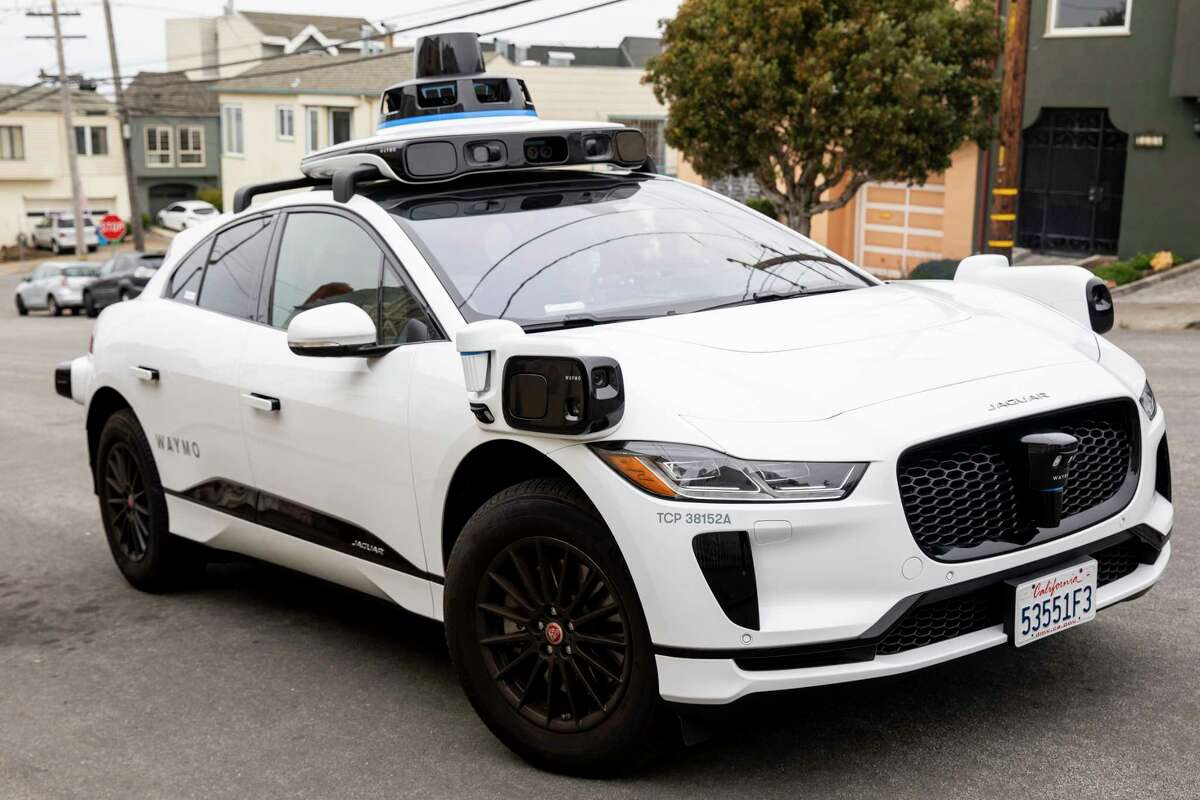
A Waymo robo taxi pulls up to a home during a demonstration ride in the Sunset District of San Francisco in 2021. As driverless cars have become more ubiquitous in San Francisco, incidents have risen, city officials say.
The number of reported traffic incidents involving self-driving taxis has surged this year in San Francisco, according to city officials seeking to block the state from giving a green light to such vehicles around the clock.
The climb coincides with recent expansion of Cruise and Waymo service on city streets and “is almost certainly a small minority of the total number of incidents actually occurring,” said a pair of May 31 letters to the state Public Utilities Commission.
Overall, the number of reported incidents climbed from 23 in January to a peak of 93 in March. The combined total for the two companies dipped to 87 in April, the last full month in which problems were tallied.
Among the more harrowing incidents: a case last month where a Cruise driverless vehicle drove through police tape at an active crime scene and a scene in January where a Waymo car entered an active construction site and stopped at the edge of an open trench with workers inside it.
The letters are the latest sign of City Hall’s unease with the potential dangers of the driverless technologies. They also come as the commission apparently is poised to begin allowing both companies to offer automated taxi service throughout nearly all the city, 24 hours a day. That’s according to draft resolutions from early May allowing such expansions. The commission’s next hearing is June 29.
Two near-identical letters — one applying to Waymo, the other to Cruise — were submitted to the commission on May 31 by the heads of San Francisco Planning, the San Francisco Municipal Transportation Agency and the San Francisco County Transportation Authority. Each opposes the “virtually unlimited expansion” of “a developmental technology that is not yet ready for unconstrained commercial deployment.”
The city’s latest letters were first reported by the San Francisco Standard. Cruise and Waymo did not respond immediately on Saturday evening for requests to comment.
San Francisco has served in a sense as a test lab for the new technology, but until now there have been tight constraints on the hours that robotaxis can be deployed as well as the neighborhoods where they are allowed. By contrast, Cruise wants to introduce a fleet of 100 vehicles that would operate around the city and around the clock — including downtown during commute hours. Waymo’s expansion would be similar.
The city’s preference is that expansion be done with specified limits and and only after full public review. But the draft decision from the state commission says that the requests for wider service meet past guidelines set up by the state Department of Motor Vehicles.
The draft decision by the Public Utilities Commission does call for Waymo and Cruise to collaborate with the city to find a “thoughtful” approach to expansion that will “minimize any negative impacts.” But the three city departments say such requests are likely to be irrelevant.
“It is unreasonable” for the state to allow expansions “before adopting expanded reporting requirements and minimum performance standards,” according to the three city departments. “This approach is backwards.”
Source: www.sfchronicle.com

GIPHY App Key not set. Please check settings