 Moderation Team
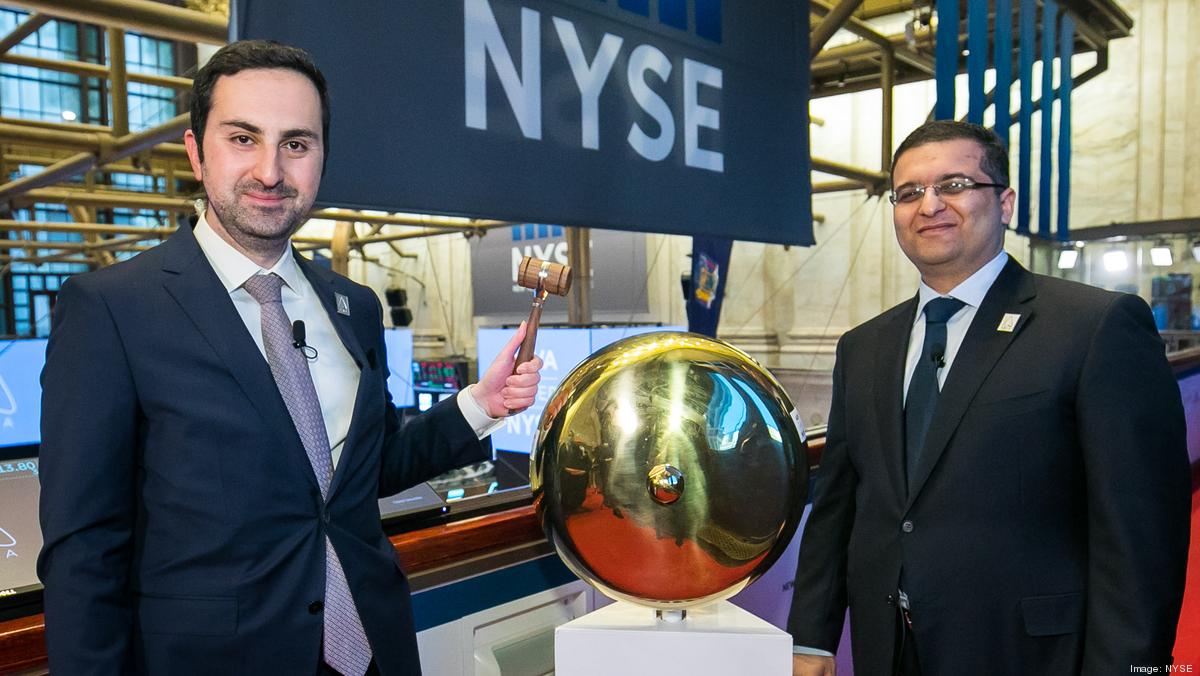
The founders of Lidar maker Aeva Inc. did something Monday most of their peers haven’t been able to do in about a year — ring an opening bell on Wall Street in person.
But CEO Soroush Salehian and Chief Technology Officer Mina Rezk don’t plan to spend much time in New York celebrating their company going public Monday. Instead, they plan to get back to Silicon Valley right away and continue working on growing their business.
“We wanted to do this right,” Salehian told the Business Journal Sunday about going to New York for Aeva’s market debut. “You typically get to do this only once. We will have a little toast afterwards, but what we can do to celebrate in New York is limited due to Covid.”
Mountain View-based Aeva closed its merger with New York “blank check” company InterPrivate Acquisition Corp. Friday. The combined company’s stock began trading on the New York Stock Exchange Monday under the ticker AEVA. It soared by as much as 45% in morning exchanges before closing with a gain of about 16%. That gave it a market cap at the end of the day of about $3.7 billion. At the time of Aeva’s last private funding round in August 2019, investors valued it at about $460 million, according to PitchBook Data.
The company plans to use the $560 million it raised in the merger to push to full production on its lidar technology, a laser-based proximity sensor used in autonomous vehicles. Aeva expects to hit full production in 2024.
“We see an inflection point among the original equipment manufacturers around 2024 or 2025, when highway autonomy is expected to happen in high volumes,” Salehian said. “We are seeing concrete plans from the makers of passenger cars and some in trucks that are projecting to go into higher volumes in those years.”
Founders say the company has an edge over rivals
Aeva faces plenty of competition. Five other Bay Area lidar companies have already gone public or plan to do so via mergers of their own, including Palo Alto-based Luminar Technogies Inc., whose market capitalization is more than double Aeva’s. Intel Corp. and Alphabet Inc. also have units working on the technology.
But Salehian and Rezk, who together co-founded Aeva, say their company’s technology gives it an edge.
Most lidar systems measure the time it takes a laser beam pulse to bounce off objects. By contrast, Aeva’s system, which it calls “4D lidar on a chip” and which is based on frequency modulated continuous wave (FMCW) technology, sends out a continuous, low-power laser beam that measures changes in the frequency of waves that are reflected off objects. FMCW-based systems can be more effective in brightly lit situations than standard lidar sensors. They are also less likely to be affected by lidar signals coming from other sources.
“When you went from black and white pictures to color, what changed? Everything, in terms of perception,” Salehian said in an interview in December, right after Aeva announced its plan to go public in a merger. “This is like that.”
Aeva may now be public, but its founders say they aren’t focused on its stock price.
“We are building a company for the long term,” Salehian said Sunday. “Our focus is to keep our heads down, focus on the product and get the customer base set up properly and deliver on the plans that we have. The stock will take care of itself as we do that.”
Building its supply chain
Their near-term plan: Double the company’s workforce of 140 over the next 12 months, add original equipment manufacturers as partners and build a supply chain.
“Our model is to outsource manufacturing to our partners, and we will have a pretty sophisticated and broad supply chain for that,” Salehian said. Aeva aims to be like Apple, he said. “They don’t manufacture, either, but they have a huge supply chain team and a complex supplier base in many different places.”
That example is one that’s well known to Salehian and Rezk, because both were engineers at the iPhone maker before founding Aeva. They recently hired Tim Willis, a supply chain veteran who worked at Apple and Waymo, to lead their efforts in that area.
“We are looking to leverage his skill set to establish that foundation for the future,” Salehian said.
Aeva plans to open offices in Europe and Asia. But unlike some companies that have decided to grow outside of the Bay Area, Aeva’s core operations will remain and continue to grow in Silicon Valley, its founders said.
“There has been a lot of great talent that has moved to the Bay Area from all over the world — from Germany, from Michigan and other places,” Rezk said. “That has established a very strong concentration of the talent we need here. For electrification and self-driving technologies, this is where the talent is.”
“it is a kind of positive feedback loop,” Salehian said. “New technology attracts new talent, which creates new technology.”
Source: www.bizjournals.com

GIPHY App Key not set. Please check settings