
 Moderation Team
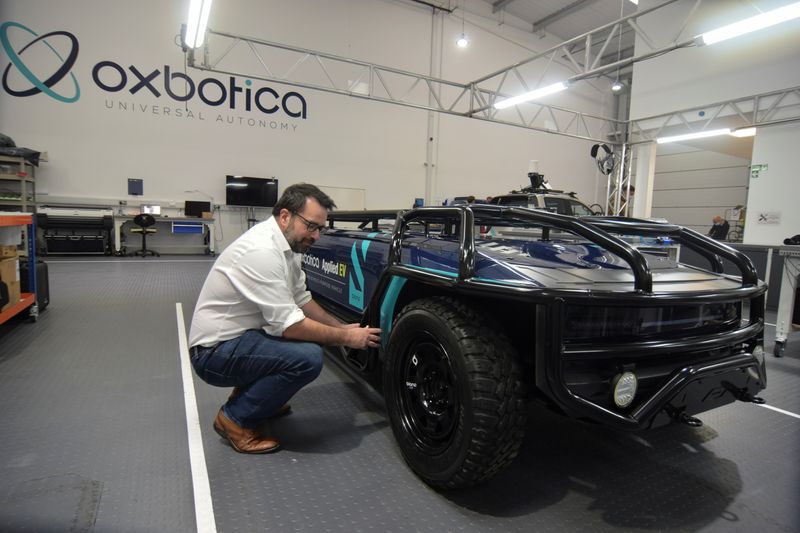
Paul Newman, founder of British autonomous vehicle software startup Oxfordica, appears next to a pickup truck used to test autonomous driving with a mining company in Oxford, England, October 22, 2021. The photo was taken on October 22nd. 2021. REUTERS / Nick Carey
December 9, 2021
By Nick Carey and Paul Lienert
Oxford, England (Reuters) -If Elon Musk was right, we would all be spinning around in a robotaxi.
Instead, fully self-driving cars are struggling to escape the starting grid, and some investors are betting that unmanned trucks will reach the checkered flag first.
Only a year ago, a startup developing Robotaxi raised eight times as much money as a company working on autonomous trucks, buses and logistics vehicles, but in 2021 the gap was dramatic. It has been reduced.
With fewer regulatory and technical hurdles, trucks operating on major highways, fixed delivery routes, or far from pedestrians such as bicycles, mines, and harbors are now faster to generate revenue. Is considered a good way.
In the year to December 6, total investment in self-driving logistics vehicles jumped from $ 1.3 billion in the same period in 2020 to $ 6.5 billion, according to startup data platform PitchBook.
Meanwhile, Robotaxi company https://reut.rs/3DEIdVU’s investment activity fell 22% from $ 10.8 billion over the same period to $ 8.4 billion, PitchBook data edited for Reuters shows. I am.
This figure may underestimate this trend, as some robotaxi companies, such as Alphabet Inc’s Waymo, are also investing more cash in their autonomous truck business.
Robotic Research said Thursday that it had raised $ 228 million in its latest truck transaction, using external investors for the first time to expand its autonomous truck, bus and logistics vehicle business.
The new funding comes from investors such as SoftBank’s Vision Fund 2, Enlightenment Capital, and Luminar Technologies, which manufactures LIDAR sensors for self-driving cars.
Alberto Lacaze, CEO of Robotic Research, told Reuters that the company is rolling out large self-driving cars whose business cases are “now” useful to customers.
“Unlike Robotaxi, which needs to reduce the cost of all sensors by orders of magnitude, you don’t have to wait until 2025,” he said.
Excessive promise
As in 2019, Tesla’s Mask promised “certainly next year” one million robotaxis, but self-driving cars that can be safely navigated anywhere are still a long way off.
Peter Rawlinson, head of electric vehicle (EV) startup Lucid Motors, said last month that even with state-of-the-art sensors, it would take a decade for a fleet of robotaxis to hit the road.
Asad Hussain, lead mobility analyst at PitchBook, said start-ups such as Gatik, which makes autonomous short-range vans, and Nuro, which has mini-delivery robots, could outperform Waymo and rival Cruise in the coming years. He said he had sex.
Still, long-distance trucks are easier to automate than robotaxis because major highways are a simpler environment than busy city roads, but how fast can executives of self-driving truck companies get up? Be careful about.
“We are very aware of the over-promise that the industry has made,” said Cheng Lu, CEO of self-driving truck technology company TuSimple, which was unveiled in April with a market value of $ 8.5 billion. I am saying.
“The industry now understands the complexity of the problem and understands that it will take longer to resolve it,” he said.
So far, TuSimple has about 50 trucks and safe drivers crossing the warm southern states of the United States, but by 2024 it will have a nationwide network covering major US highways. I plan to have it.
This includes highway mapping, learning how to deal with harsh weather and road conditions in the north, and a major investment in a new self-driving truck being developed by Navistar, part of Volkswagen’s Traton. It is included.
‘Long journey’
However, self-driving trucks still face a major challenge for human drivers, so it can take years to truly deploy a nationwide network.
Ralf Klaedtke, Chief Technology Officer of TE Connectivity, says that self-driving cars will always brake when they encounter a “human man with testosterone.” It manufactures sensors and electronic systems that process large amounts of autonomous driving data for the automotive industry.
“Self-driving cars are always the slowest in mixed traffic,” he said.
Paul Newman, founder of UK self-driving car software startup Oxbotica, states that robotaxis continued to be his clear long-term goal, the “North Star.”
But for now, he’s focused on simpler applications, some of which use a fully electric self-driving car dedicated to the Australian startup Applied EV.
“This is a long way to go,” he says, showing off a test vehicle at the company’s headquarters in Oxford, England. “This is one of the most difficult engineering problems to solve.”
Oxbotica is working on mining vehicles in partnership with Wenco, which is part of Hitachi Construction Machinery, and is working on a variety of options with energy company BP, including vehicles for remote wind power and solar farms.
Morag Watson, senior vice president of digital science and engineering at BP, said Oxbotica’s technology can monitor large sites and bring equipment to repairers. She said she will test many different options in 2022.
“We just barely scratched the surface of what industrial autonomy can do,” Watson said.
Oxbotica is also working with UK online food delivery and technology company Ocado, which automates supply chain systems such as the US retail chain Kroger. Both BP and Ocado are investing in Oxbotica.
Alex Harvey, Head of Advanced Technology at Ocado, said Oxbotica’s technology can be used “on the curb to a warehouse, yard, road, or kitchen.”
Do not turn left!
Outrider, an autonomous EV maker in the United States, is targeting delivery yards. After the truck driver unloads the trailer, he receives the trailer and carries away the new trailer side by side. This includes the Chicago Yard of the paper company Georgia-Pacific.
Outrider has developed a robotic arm for trucks to connect and disconnect trailers. With $ 118 million raised so far, CEO Andrew Smith says it will scale up to thousands of vehicles over the next five years.
Startups want to start short hops between yards, but running on public roads adds complexity, Smith said.
“We saw the early hype of technology and realized it was the perfect short-term solution with repetitive slow-moving operations in a limited environment,” he said.
Going out on public roads requires careful travel, not only because of regulation, but also because of legal pitfalls in the litigation market such as the United States.
Ian White, CEO of digital insurance company Koffie Labs, said the “Black Swan’s $ 1 billion” crash could wipe out companies that are moving too fast and wrong.
“You will put the balance sheet on the line,” he said.
That’s why Gatik chose a cautious approach to the “middle mile” delivery route between distribution centers and retailers, said CEO Gautam Narang.
Gatik trucks travel short, predictable routes, avoiding left turns on complex objects such as oncoming vehicles, schools, hospitals, fire departments, and blind turns.
“We are not working on all the tricky situations that the self-driving car industry is trying to solve,” he said. “We are taking the baby’s step by using a route that is not a problem in terms of complexity.”
Gatik works with Walmart Inc and Loblaw Companies Ltd using self-driving trucks with safety drivers, but operates unmanned driving routes in Arkansas and sees a global shortage of drivers as an opportunity. ..
“We decided to focus on simpler use cases where the needs are very serious,” says Naran. “We are not building technology for technology.”
(Report by Nick Cary of Oxford and Paul Lienato of Detroit, edited by David Clark)
Source: texasnewstoday.com


GIPHY App Key not set. Please check settings