Driverless cars may be inching closer to mainstream use, but there’s one obstacle even the smartest algorithms still struggle to master — snow. When the roadways turn white in the winter months, the cameras, lidar, and radar sensors that keep autonomous vehicles on course suddenly face a world they can’t easily interpret. Snow can obscure lane markings, reflect light unpredictably, and even mimic physical objects, confusing the perception systems that driverless cars depend on.
According to reporting from The Verge, Waymo, Alphabet’s self-driving car division, has been quietly testing its robotaxis in wintry conditions to learn how they perform when visibility drops and traction disappears. The goal is simple: to make autonomous cars as capable in sleet and snow as they are on dry pavement. However, the challenge is immense, presenting a problem to companies that want to send their robotaxis to different U.S. cities and beyond.
The sensors that detect pedestrians and road edges can get coated in slush and cause GPS accuracy to dip, especially in dense snowstorms, and icy roads complicate braking predictions. Still, self-driving car companies like Waymo aren’t backing down. According to The Verge, they’re training their vehicles through thousands of simulated snow scenarios and real-world tests in cold-weather cities to teach their AI how to handle the unexpected. The results thus far suggest that driverless cars can work in the snow, just not flawlessly, at least yet. Let’s break down why winter driving is so tough for autonomous systems, and what the industry is doing to make all-weather robotaxis a reality.
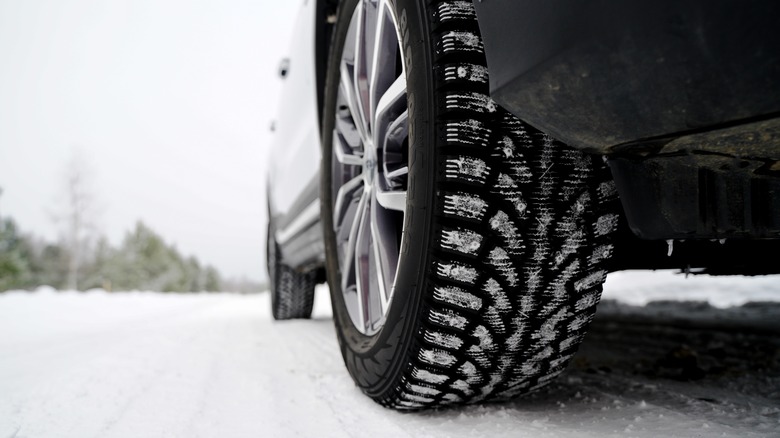
How snow confuses self-driving sensorsUltraskrip/Shutterstock
For all their advanced hardware and AI training, driverless cars still rely on a clear view of the world to make sense of it, and snow has a knack for blurring that view in more ways than one. Cameras, lidar, and radar are the “eyes” of any autonomous vehicle, but when flakes start falling, those sensors can misread what’s happening around them. A thin layer of snow can hide lane lines, curb edges, and road markings, making it difficult for onboard vision systems to determine where the car actually is.
Lidar, which builds 3D maps by bouncing laser light off surfaces, also struggles when snowflakes reflect or scatter those same laser beams, creating a “ghost” effect that fills the sensor with false readings. Meanwhile, radar can mistake heavy snow or slush for solid objects, causing the vehicle to overcorrect or slow unnecessarily. Even something as simple as snow accumulation on the sensor housings can blind a car completely, forcing it to pull over or shut down.
Waymo and other companies have started developing self-heating sensors, improved filtering algorithms, and AI models trained on snowy data to combat these issues. By teaching autonomous systems to recognize the difference between a drifting snowflake and a stationary hazard, engineers hope to make robotaxis that can one day handle even the harshest blizzards, without a human having to take the wheel.
We use cookies on our website to give you the most relevant experience by remembering your preferences and repeat visits. By clicking “Accept All”, you consent to the use of ALL the cookies. However, you may visit "Cookie Settings" to provide a controlled consent.
This website uses cookies to improve your experience while you navigate through the website. Out of these, the cookies that are categorized as necessary are stored on your browser as they are essential for the working of basic functionalities of the website. We also use third-party cookies that help us analyze and understand how you use this website. These cookies will be stored in your browser only with your consent. You also have the option to opt-out of these cookies. But opting out of some of these cookies may affect your browsing experience.
Necessary cookies are absolutely essential for the website to function properly. These cookies ensure basic functionalities and security features of the website, anonymously.
Cookie
Duration
Description
cookielawinfo-checkbox-analytics
11 months
This cookie is set by GDPR Cookie Consent plugin. The cookie is used to store the user consent for the cookies in the category "Analytics".
cookielawinfo-checkbox-functional
11 months
The cookie is set by GDPR cookie consent to record the user consent for the cookies in the category "Functional".
cookielawinfo-checkbox-necessary
11 months
This cookie is set by GDPR Cookie Consent plugin. The cookies is used to store the user consent for the cookies in the category "Necessary".
cookielawinfo-checkbox-others
11 months
This cookie is set by GDPR Cookie Consent plugin. The cookie is used to store the user consent for the cookies in the category "Other.
cookielawinfo-checkbox-performance
11 months
This cookie is set by GDPR Cookie Consent plugin. The cookie is used to store the user consent for the cookies in the category "Performance".
viewed_cookie_policy
11 months
The cookie is set by the GDPR Cookie Consent plugin and is used to store whether or not user has consented to the use of cookies. It does not store any personal data.
Functional cookies help to perform certain functionalities like sharing the content of the website on social media platforms, collect feedbacks, and other third-party features.
Performance cookies are used to understand and analyze the key performance indexes of the website which helps in delivering a better user experience for the visitors.
Analytical cookies are used to understand how visitors interact with the website. These cookies help provide information on metrics the number of visitors, bounce rate, traffic source, etc.
Advertisement cookies are used to provide visitors with relevant ads and marketing campaigns. These cookies track visitors across websites and collect information to provide customized ads.

 Moderation Team




GIPHY App Key not set. Please check settings